Is It a Sin to Hire Undocumented Workers?
A Catholic Social Teaching Perspective on Law, Work, and Moral Responsibility
by CAPP-USA

Catholic social teaching gives guidance on hiring undocumented workers.
30-Second Summary
Is it a sin to hire undocumented workers? Catholic Social Teaching does not offer a simple yes or no. Exploitation is always gravely wrong. Just treatment may be morally defensible but remains in tension with legal and systemic concerns.
The deeper issue is a disordered system that depends on labor it does not fully recognize. The task is not to choose between law and compassion, but to hold together human dignity, the common good, and moral responsibility in every specific decision.
The Dignity of Work Comes First
For many employers, this is not an abstract question. It is immediate, practical—and often deeply unsettling. A business owner needs workers. A worker needs a job. The law is clear. The moral judgment is not.
Catholic Social Teaching always begins in the same place: the dignity of the human person. Work is not merely economic activity; it is a participation in God’s creative action. As Pope Leo XIII teaches, to treat workers “as though they were things” in pursuit of gain is “shameful and inhuman.” (Rerum Novarum, 20) (See: Dignity of Work)
That judgment does not depend on legal status. The rights of workers flow from their human nature—not from citizenship, documentation, or legal classification. An undocumented worker does not lose his humanity at the border.
The Law Matters — But It Is Not the Whole Question
At the same time, the political community has real authority. Employment laws exist to preserve order, protect workers, and promote the common good — and the Church takes them seriously. Nations may regulate their borders with regard to the common good, while also being obliged to welcome those in need. (Catechism of the Catholic Church, 2241)
To ignore the law is to weaken the common good. To ignore the person is to betray it.
The real question, then, is not simply: Is it a sin to hire an undocumented worker?
The more demanding question is: Does this particular act of hiring contribute to justice — or to exploitation?
The same external act can carry very different moral weight depending on intention, circumstance, and effect.
In practice, three patterns tend to emerge.
How Moral Judgment Applies in Practice
The Church does not leave this question entirely abstract. It unfolds in concrete decisions, where the moral stakes are real and unavoidable.
Moral judgment tends to fall into three recognizable patterns — not as rigid categories, but as ways of understanding how intention, circumstance, and effect shape the moral weight of an action.
FIRST PATTERN
The first is the clearest. When an employer hires in order to take advantage of a worker’s vulnerability—paying less than a just wage, denying protections afforded to others, avoiding legitimate obligations, or using the threat of deportation to silence complaint—the moral judgment is straightforward.
This is not assistance. It is exploitation. It violates justice, undermines the dignity of the worker, and reduces the person to an instrument of gain. As the Catechism teaches, fraudulent practices in wages and treating workers as mere sources of profit are serious moral wrongs. (Catechism of the Catholic Church, 2408-2409) In such cases, the sin is not ambiguous — and no business rationale changes that verdict.
SECOND PATTERN
A second pattern is more difficult, and it is here that many employers find themselves. The intention is not to exploit, but to employ justly. The worker is paid fairly, treated with respect, and given conditions no different from any other employee. The employer does not use legal status as leverage, and may even be responding to a genuine human need.
And yet the tension does not disappear. Catholic moral reasoning asks whether the employer is intending wrongdoing or acting within circumstances not of his own making; whether the worker faces real necessity with no legal alternative available; and whether the act, taken as a whole, upholds dignity or contributes to a structure that ultimately undermines it.
It is worth noting that paying workers off the books — even with just wages — adds further moral complications: it evades taxes that fund the common good, denies workers Social Security credits, and deepens their vulnerability rather than relieving it. If such an arrangement is ever justifiable at all, it can only be as a genuine last resort, never as a convenient business practice.
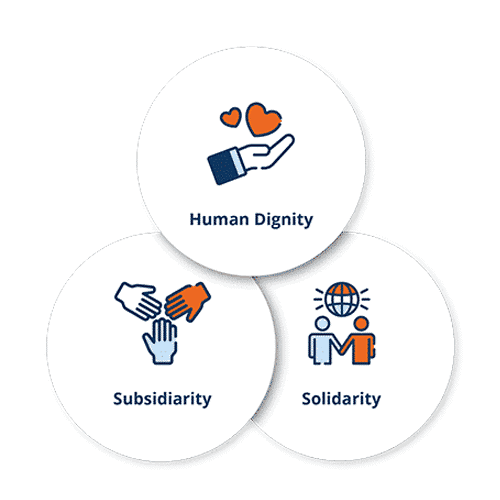
Here, the principle of subsidiarity becomes essential: moral responsibility begins with the person who must act in conscience within his circumstances—yet always in a way that supports, rather than undermines, the broader order of justice and the common good (Pope Pius XI; Pope St. John Paul II).
In this second case, the employer may not be cooperating in injustice in any direct sense, but neither is the moral burden removed entirely. The judgment is prudential, and it requires an honest reckoning with both the good being done and the tensions that remain. The fact that an action may be defensible does not make it neutral; it still carries a moral weight that must be answered for in conscience.
A concern sometimes raised is whether hiring undocumented workers harms those who are here legally and competing for the same jobs. Catholic teaching takes this seriously. Workers with legal status have genuine claims that deserve respect, and labor markets should function transparently and justly.
But the answer is not to pit workers against one another. Exploitation of any worker — documented or not — ultimately depresses wages and conditions for everyone. The Catholic response is to insist on just wages and enforced labor standards for all, and to advocate for a system that does not force this choice in the first place.
THIRD PATTERN
The third pattern represents the clearest alignment of law and moral order. Where an employer follows legal hiring requirements, verifies work authorization, and treats all workers with justice and dignity, both the demands of civil authority and the rights of the human person are respected.
This path does not resolve every broader systemic issue, but it does provide a stable and coherent moral footing.
These three patterns do not reduce the question to a formula. They clarify it. They show that the same external act—hiring—can take on very different moral meanings depending on how and why it is done. And they point back to the central question that must guide every case:
Is this action ordered toward justice—or does it make use of another’s vulnerability?
The Deeper Disorder
At this point, the focus must widen — because the problem does not begin with the individual employer.
A system is morally disordered when it depends on labor it refuses to regularize, offers no realistic legal pathway for those who perform necessary work, and leaves millions vulnerable to exploitation while benefiting from their presence. This is not simply an economic failure. It is a failure of solidarity and justice.
As Pope Benedict XVI and Pope Francis teach, solidarity calls us to recognize every person — native or immigrant, documented or undocumented — as a neighbor. But solidarity without realism is not compassion. When systems consistently produce exclusion and vulnerability, the issue is no longer merely individual—it is structural.
Catholic Social Teaching's response is accordingly systemic: legal pathways that match economic reality, protections for all workers regardless of status, enforcement of labor standards rather than immigration status alone, and international cooperation to address the root causes of migration.
Practical Guidance for Employers
For those who hire, the moral obligation is clear regardless of circumstance: wages must be just, conditions must be safe, and the dignity of every worker must be respected without exception. A worker’s legal status can never be used as leverage — not to reduce pay, not to avoid obligations, not to suppress complaints. Any decision to hire must be made with clear eyes about the legal risks involved and a genuine commitment to treating the worker as a person, not a convenience.
For those who choose not to hire undocumented workers, the moral responsibility does not end there. Recognizing the dignity of the immigrant means more than a hiring decision. It means considering whether you can help connect individuals to legal assistance, support parish ministries or community organizations that serve immigrant families, or advocate for reforms that better align the law with the human realities it governs.
In either case, the question is the same: are you contributing to justice, or to exploitation?
Final Word
So—is it a sin?
Yes, gravely, when hiring is exploitative. The vulnerability of another person is never a resource to be used.
Sometimes it is more complicated. When hiring is just in intention and execution, the moral burden shifts — but does not disappear, and legal tensions remain. Good intentions do not dissolve moral complexity; they are the beginning of navigating it honestly.
But the deeper question remains constant: Does this action uphold the dignity of the person—or exploit it?
That is the measure Catholic Social Teaching demands. And it is a standard that admits no shortcuts.
As Christians, we are called to see Christ in every worker — documented or not.
Immigration Series Part 1 — Is Undocumented Immigration a Sin?