The Ukraine War and Catholic Social Teaching
by CAPP-USA
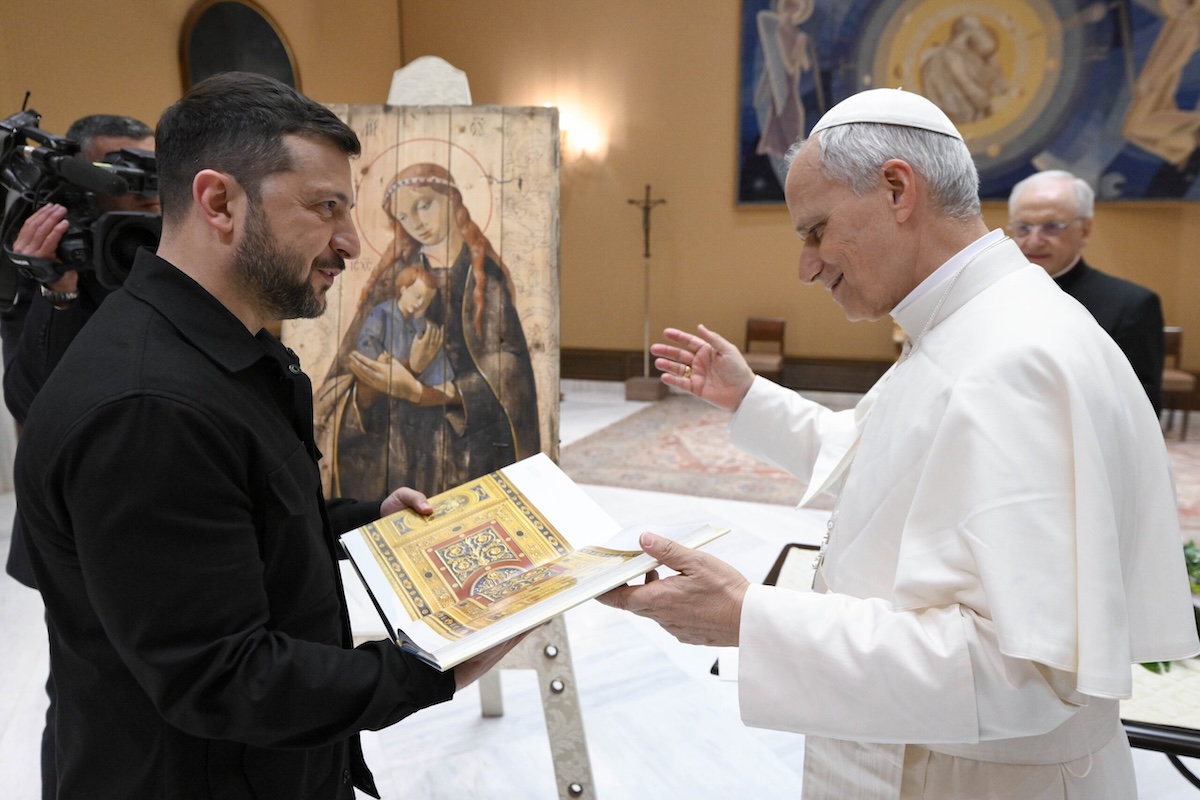
Pope Leo XIV has urged peace and an end to the Ukraine War, citing Catholic social teaching. (CNS photo/Vatican Media)
Continuity of the Church’s Teaching on War and Peace: From Pope Francis to Pope Leo XIV
What began in February 2022 as a military invasion—condemned swiftly by Pope Francis as a grave injustice and an assault on human dignity—has evolved into a protracted humanitarian and geopolitical crisis now entering its fifth year.
The continuation of the conflict through the transition from Pope Francis to Pope Leo XIV has brought a renewed emphasis on a humane resolution and a rejection of the “logic of weapons.” (Angelus, August 31, 2025)
This continuity reflects a central conviction of Catholic social teaching: peace is built by justice rooted in human dignity. As Pope Leo XIV stated in January 2026: “I am following the situation with sorrow, and I am close to and pray for those who suffer. The continuation of hostilities, with increasingly serious consequences for civilians, widens the rift between peoples and pushes further back the opportunity for a just and lasting peace. I invite everyone to intensify their efforts to end this war.” (Angelus, January 25, 2026)
Building directly on Pope Francis’s repeated warnings against dangerous escalations, his urgent calls for real negotiations, ceasefires, and an end to the “nightmare of war” Pope Leo XIV has deepened this magisterial initiative by highlighting the moral and spiritual roots of prolonged conflict.
As the destruction of homes, hospitals, schools, and energy infrastructure continues—stealing futures from an entire generation of Ukrainians and exacerbating winter hardships—the Church’s voice grows ever more insistent on solidarity, charity, and diplomacy over force.
The Root Cause: Pride and the Mentality of Confrontation
Pope Leo XIV identifies pride as a deeper moral root of the conflict. “[P]ride is always at the root of every conflict.” (Address to Diplomatic Corps, January 9, 2026)
He links the moral disorder of pride to the collapse of realism, empathy, and ultimately peace: “It is no coincidence that pride is always at the root of every conflict. Consequently, as I recalled in my Message for the World Day of Peace, ‘we lose our sense of realism and surrender to a partial and distorted view of the world, disfigured by darkness and fear,’ (14) thus paving the way for the mentality of confrontation, which is the precursor to every war.” (Address to Diplomatic Corps, January 9, 2026)
This shift in emphasis marks a faithful development: from Francis’s initial outcry against forgotten humanity to Leo XIV’s diagnosis of pride as the deeper disorder fueling distorted views of reality and the “mentality of confrontation.”
Solidarity in the Face of War
Pope Leo XIV has emphasized that solidarity must transcend “this senseless war”. (Address to Pilgrims of Ukrainian Greek-Catholic Church, 28 June 2025) “I ask everyone not to give in to indifference, but to draw close to them through prayer and concrete gestures of charity.” “The voice of weapons must be silenced, while the voice of fraternity and justice must be raised.” (Angelus, August 31, 2025)
In February 2026, following renewed bombings of energy infrastructure, Pope Leo XIV demonstrated the Church’s “drawing close through concrete gestures of charity” with tangible actions: sending generators, food, and medicine to Ukraine to counter freezing conditions and infrastructure hits from attacks. (Vatican News)
Conclusion: A Moral Crossroads
Pope Leo XIV has framed the current era as an “epochal change,” where the global community must decide between regaining “moral and spiritual dignity” or falling into the “cesspool” of perpetual violence. (Dilexi Te, 95) In this long crisis the Church remains a “beacon that illumines the dark nights,” (Homily, College of Cardinals, May 9, 2025)
This moral crossroads is precisely where Catholic social teaching situates political responsibility: not in strategic advantage, but in the protection of human dignity and the pursuit of justice among nations.
The Church calls for diplomacy to replace force with dialogue:
“I make an urgent appeal to the international community not to waver in its commitment to pursuing just and lasting solutions that will protect the most vulnerable and restore hope to the afflicted peoples. I likewise emphasize the Holy See’s full willingness to support any initiative that promotes peace and harmony.” (Address to Diplomatic Corps, January 9, 2026)
Watch Pope Leo XIV’s full “State of the World” address, in which he outlines his vision for global peace and directly addresses the war in Ukraine.
The Ukraine War and the International Work for Peace




CAPP-USA (Centesimus Annus Pro Pontifice, Inc.) is the United States affiliate of the Vatican-based pontifical foundation of Fondazione Centesimus Annus Pro Pontifice, established by Pope St. John Paul II in 1993 to promote Catholic Social Teaching in fidelity to the Magisterium of the Catholic Church. CAPP-USA is a 501(c)(3) nonprofit organization.