When There Is No Path to Citizenship
Part 4: Law, Conscience, and the Need for Reform
by CAPP-USA
What happens when a person has lived responsibly for years—working, raising a family, contributing to society—yet the law offers no realistic path to legal status? Catholic Social Teaching does not dismiss law, but it insists that law must remain ordered to the human person and the common good. When legal structures cannot reconcile moral reality with legal status, the problem is no longer merely personal. It becomes structural. At that point, reform is no longer merely political. It becomes a matter of justice.
Building on What Came Before
In Part 1, we distinguished between legal violation and moral culpability.
In Part 2, we saw how that distinction unfolds in real lives.
In Part 3, we clarified what is required of both immigrants and nations.
Now the question deepens further:
What happens when the law offers no path forward?
At that point, the problem is no longer only personal. It becomes structural. A legal system that cannot reconcile legal status with moral reality reveals its own limits.
The Contradiction at the Heart of the System

If there isn't a path to citizenship and legal status, the system is flawed and in need of reform.
Consider a situation that is no longer exceptional—it is increasingly common.
A person may have entered unlawfully, perhaps under conditions of genuine necessity or hardship. Over time, that person builds a life marked not by disorder, but by responsibility: working, raising a family, contributing to the community, participating in the life of the Church.
And yet, legally, nothing has changed.
The person remains permanently out of status—often with no meaningful path toward regularization.
This is not merely a difficult circumstance. It is a contradiction embedded within the structure of the law itself.
As this series has shown, a person may violate civil immigration law yet bear little or no moral culpability when acting under genuine necessity.
They may even be fulfilling fundamental civic duties and contributing to the common good.
When these realities diverge temporarily, tension exists. When they remain unresolved for years—or decades—the tension becomes structural.
Catholic Social Teaching does not conclude from this that law no longer matters. It concludes something more demanding:
Human law must remain capable of recognizing basic moral reality. When it cannot, the law itself stands in need of reform.
When Law Cannot Reconcile with Moral Reality
The Church does not dismiss law. It affirms its necessity. Social order, political authority, and legal frameworks all serve the common good—and are indispensable to civilized life.
But Catholic Social Teaching also insists that law is not an end in itself.
Laws exist for the person—not the person for the law.
When a legal framework creates conditions in which long-term residents can neither regularize their status nor fully participate in society, when families remain permanently insecure despite years of stable contribution, when social belonging is acknowledged informally but denied legally, the question must eventually be asked:
Is the fault solely in the person? Or does the structure itself bear responsibility?
Catholic Social Teaching answers clearly: when human law cannot accommodate fundamental moral realities, the law itself stands in need of reform.
This is not an argument against enforcement. It is an argument against the permanence of contradiction.
Living in Moral Integrity Amid Legal Limbo
Even within this unresolved condition, the moral life does not collapse. In many ways, it becomes more demanding.
Catholic Social Teaching offers guidance for living responsibly within legal uncertainty. Not by ignoring the law, but by refusing to abandon moral responsibility because the law remains unresolved. That guidance unfolds across four essential relationships.
BEFORE GOD
A person’s relationship with God is not determined by immigration status.
If the original act occurred under genuine necessity, and the person now seeks to live honestly, fulfill obligations, and pursue lawful paths where possible, they may stand before God with a clear conscience.
Legal uncertainty does not place a person outside the reach of grace, nor outside the concern of the Church.
BEFORE FAMILY
The duty to protect and provide for one's family is fundamental.
When migration occurs in order to fulfill this obligation, especially under conditions of hardship or danger, the moral weight shifts. The obligation to family is not secondary to administrative requirements. It is prior to them.
BEFORE CONSCIENCE
Conscience requires honest examination, not rationalization, not self-justification.
A person must still ask difficult questions: Was this truly necessary—or merely convenient? Am I contributing honestly to the community in which I live? Am I seeking lawful resolution where it exists?
A well-formed conscience can find peace even within legal uncertainty, but only when grounded in truth, responsibility, and sincere effort to do what is right.
BEFORE THE POLITICAL COMMUNITY
Even in irregular status, obligations to the broader community remain.
As established in Part 3, this includes contributing to the common good through honest work and participation, respecting laws that protect public safety and order, pursuing legal pathways wherever they exist—however limited—and advocating, appropriately, for just reform.
Legal status may be unresolved. Moral responsibility is not suspended.
The Limits of Moral Justification
This framework depends on a critical condition: genuine necessity.
As emphasized throughout this series, moral mitigation applies most clearly when migration occurs under conditions of serious hardship, danger, or inability to sustain basic family life.
The further one moves from those realities, the weaker the moral justification becomes.
Catholic Social Teaching does not provide a blanket defense of unlawful migration. It offers something more disciplined: a framework for careful moral judgment rooted in circumstance, intention, proportionality, and responsibility.
That distinction matters greatly. Without it, moral reasoning collapses—either into permissiveness or into rigidity.
The Church accepts neither.
Guidance for Pastors and Those Who Serve Immigrants
For pastors, counselors, parish leaders, and those accompanying immigrants in these situations, the task is both moral and pastoral.
It begins by recognizing the person before the category. Legal status does not determine human worth before God—nor does it tell the whole story of a person's life.
Pastoral care, therefore, requires more than legal awareness. It requires affirming the dignity of the person, honestly examining circumstance, and helping individuals distinguish legal violation from moral culpability without falling into either harshness or false comfort. It requires asking difficult questions with sincerity: Was there genuine necessity? Are lawful options available now? What responsibilities remain toward family, community, and the broader society?
At the same time, the Church must remain a place of hope. God’s mercy is not withheld because a legal system is broken. Those living in uncertainty must still be accompanied toward truth and responsibility—encouraged to pursue lawful paths where they exist, and to advocate
appropriately for a system more capable of serving justice.
Practical accompaniment also matters. Where available, this may include connecting individuals with Catholic legal services, qualified immigration professionals, and parish or community resources capable of offering responsible assistance.
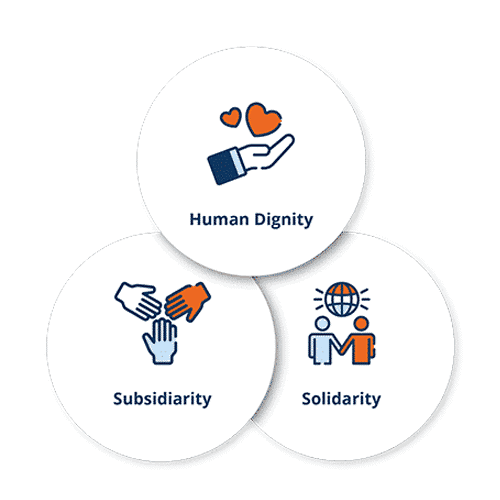
One limit must be named clearly: pastoral care must remain pastoral. Legal questions require legal expertise. The principle of subsidiarity reminds us that different responsibilities belong to different levels of authority: pastoral accompaniment cannot substitute for legal judgment, nor can legal structures ignore moral reality.
The Church accompanies the person morally and spiritually—it does not replace competent legal counsel.
From Contradiction to Reform
Parts 1 through 3 established the principles, applied them to real lives, and clarified the responsibilities of persons and nations.
Part 4 reveals something further:
When a system produces widespread and enduring contradictions between legal status and moral reality, the issue is no longer merely individual.
It is structural.
A legal framework that offers no path toward reconciliation for those who acted under necessity, lived responsibly, and became part of the social fabric does not fully serve the common good.
At that point, reform is no longer a matter of political preference.
It becomes a matter of justice.
What Comes Next
This leads to the final question: what would a just and workable path to citizenship actually require?
Next: Part 5 — Immigration Reform and the Path to Citizenship