Address by His Eminence Cardinal Pietro Parolin
Secretary of State to CAPP-USA, September 2026
A Fragmented World in Search of Spirituality
Freedom and Pluralism from within the Social Doctrine of the Church
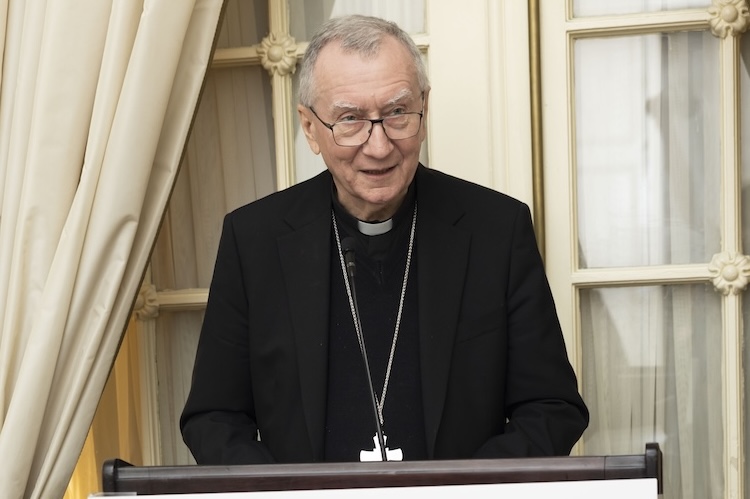
Cardinal Parolin to CAPP-USA regarding our fragmented world and the impact of Magnifica Humanitas.
Excellencies,
Distinguished guests,
Dear friends,
I am delighted to be with you this evening for the Centesimus Annus Pro Pontifice USA Foundation dinner. Let me begin by thanking the President and the Members of the Foundation for the kind invitation to join you for this occasion.
I am honoured to bring you the cordial greetings of the Holy Father, Pope Leo XIV. He is grateful for your support for the Successor of Peter and for your commitment to making the Social Teaching of the Church known and lived in business, in the professions, and in academic life.
Your Foundation takes its name from the Encyclical Centesimus Annus, in which Pope Saint John Paul II marked the hundredth anniversary of Rerum Novarum. Last May, on the one hundred and thirty-fifth anniversary of Rerum Novarum, Pope Leo XIV gave the Church Magnifica Humanitas. This highlights the profound continuity of the Church’s Social Teaching: in the light of the Gospel, each generation must read the signs of its own times.
Dear friends,
Your theme for this year is “A Fragmented World in Search of Spirituality: Freedom and Pluralism from within the Social Doctrine of the Church.” In the light of the Church’s Social Teaching, I would like briefly to reflect on that title in three steps.
A Fragmented World
First, a fragmented world. We are more connected than any generation in history, and yet many of us are lonelier than ever. We exchange information instantly but struggle to encounter one another. We may have thousands of followers online and yet hardly any friends. We see families, communities and nations divided into camps that no longer even speak the same language.
Pope Leo XIV describes this moment in the opening lines of Magnifica Humanitas. Humanity faces a choice: either to “construct a new Tower of Babel,” or to build the city in which God and humanity dwell together. Babel is the image of a project built by people who have lost a shared language and, above all, a shared reference point beyond themselves.
The Social Doctrine of the Church locates the root of fragmentation precisely there. It lies not in technology or diversity as such, but in the loss of a common understanding of who the human person is. When we forget that every person bears an inherent dignity that precedes any law, market or algorithm, unity has nothing left to rest upon.
In Search of Spirituality
Second, in search of spirituality. A fragmented world is also a searching world. The restlessness we observe, especially among the young, is not the absence of spiritual hunger but, in many ways, evidence of it. Saint Augustine understood this long ago: the human heart is made for God, and it remains restless until it finds Him. (Cf. St. Augustine of Hippo, Confessions)
The Church’s Social Doctrine is itself an expression of the spiritual life. It is faith that becomes concern for the worker, the family, the poor, seeking the common good. It reminds us that the human person is not self-made but received, a being created for relationship. Indeed, Pope Leo XIV expresses the hope that the world “will come to recognise the human heart as the place where God desires to dwell.” (Magnifica Humanitas, 16)
Freedom and Pluralism
Third, freedom and pluralism. It would be easy to blame our fragmentation on these two factors: too much freedom, too many voices. The Church does not do that. In fact, she defends both: freedom is a gift inseparable from human dignity; and the Second Vatican Council affirmed religious freedom as a right rooted in the very nature of the human person. Pluralism is a genuine good in a free society.
Yet freedom detached from truth, and from responsibility for others, turns against itself. In the Christian vision, freedom is not the capacity to choose anything whatsoever; it is the capacity to choose the good, and to choose it together.
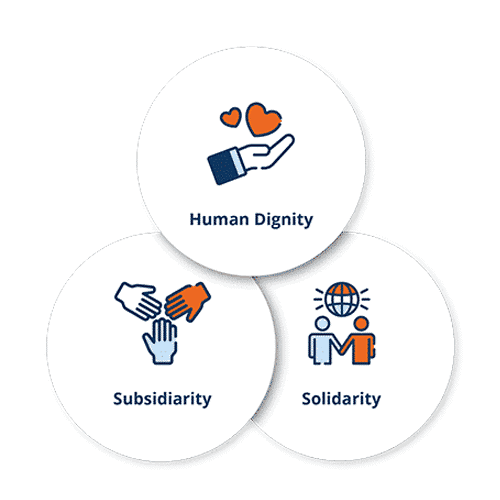
Likewise, authentic pluralism is not a collection of isolated voices. It rests on the principles that Catholic Social Doctrine has long proposed: human dignity; the common good; solidarity, which binds us to one another; and subsidiarity, which respects the families, communities and institutions through which people flourish. These principles make difference possible without division.
In Magnifica Humanitas, Pope Leo XIV focuses on this. Technology, he says, is not “a force antagonistic to humanity.” (Magnifica Humanitas, 14) It isn’t the enemy. But he also reminds us that history changes for the better “when individuals truly take the dignity of everyone seriously.” (Magnifica Humanitas, 124)
In other words: not systems, not algorithms, but people. That means people who hire, invest, teach, legislate, and decide. In short, that describes a good many of you in this room tonight.
That is precisely why your Foundation matters. You are, in a very real sense, the bridge-builders between the Encyclicals I have mentioned and the decisions of daily life. Allow me, then, to leave you with a simple charge: in a world that builds towers, build places of encounter; in a world connected online and disconnected offline, be people of presence; in a world asking whether we can remain human, answer with the witness of your lives.
Upon you, your families and all your endeavours, I invoke the blessing of Almighty God.
Thank you.
Catholic World Report Coverage
Cardinal Parolin’s Address to CAPP on Generative AI, June 2024
Cardinal Parolin’s Address to CAPP on AI Ethics, September 2024



CAPP-USA (Centesimus Annus Pro Pontifice, Inc.) is the United States affiliate of the Vatican-based pontifical foundation of Fondazione Centesimus Annus Pro Pontifice, established by Pope St. John Paul II in 1993 to promote Catholic Social Teaching in fidelity to the Magisterium of the Catholic Church. CAPP-USA is a 501(c)(3) nonprofit organization.