The Spirituality of the Social Doctrine of the Church for a Fractured World
Reflections on attending the Foundation’s General Assembly and International Conference, held on the 28th and 29th of May
by Dr. Karen Shields Wright
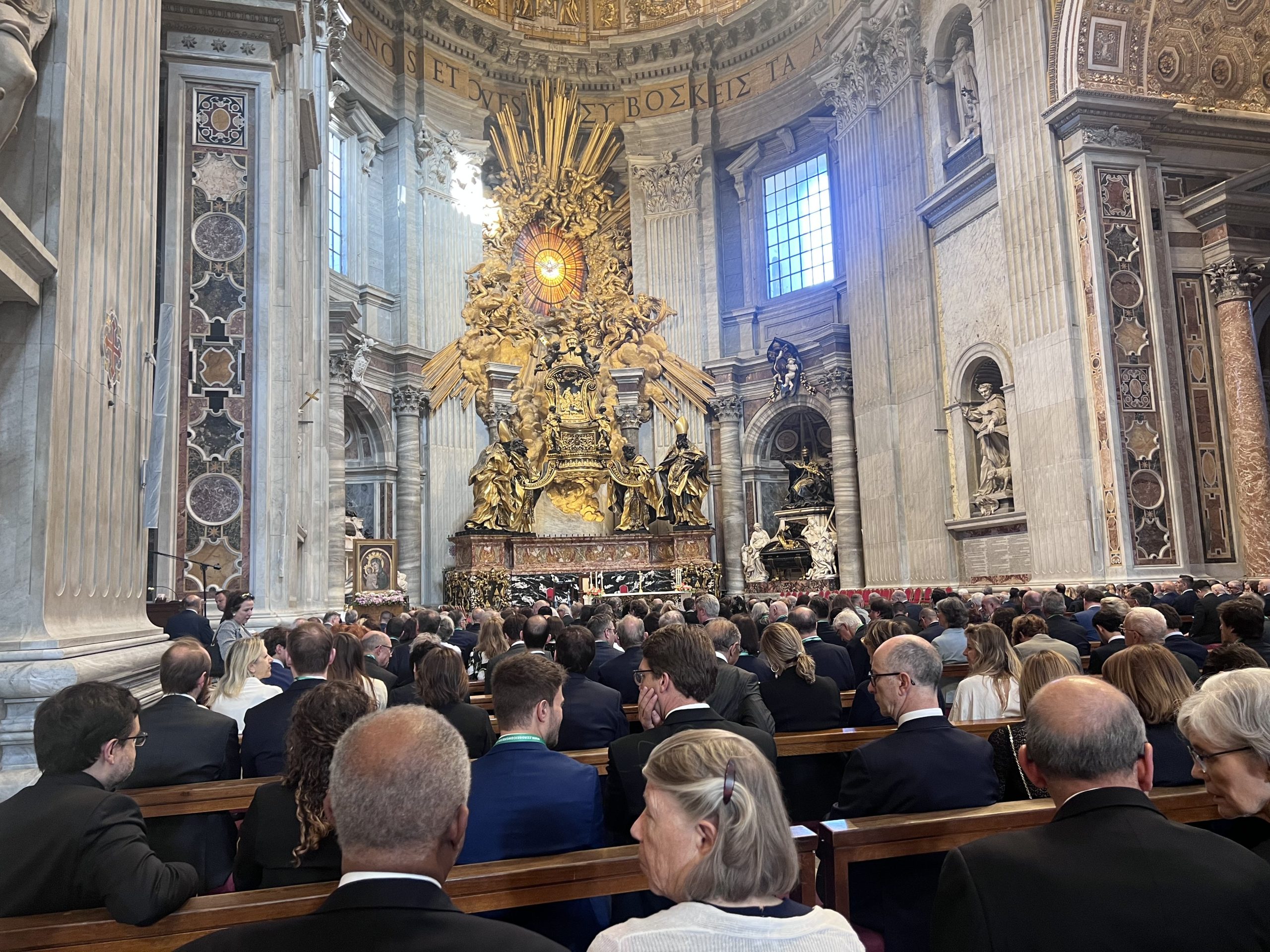
Mass in St. Peter’s Basilica during the 2026 CAPP International Conference
Dear Friends in Christ,
In Pope Leo XIV’s encyclical Magnifica Humanitas, we are reminded of the magnificent gift of being human, and of God’s love for us in becoming one of us to share in our sufferings and our joys. It is from within this great mystery of gift and grace that I wish to share with you what I carried home from these recent days together: hope, a hope filled with the grace of consolation.
Where We Gathered
The Foundation’s General Assembly and International Conference was held on the 28th and 29th of May. It concluded with Mass at St. Peter’s and a private audience with the Holy Father, who spoke to the assembly of participants and guests where Pope Leo encouraged us that, as members of the Body of Christ, we have a mission: to study and to implement the social doctrine in the very content of our personal and professional lives.
The theme chosen for this year, A Fragmented World in Search of Spirituality: Freedom and Pluralism from Within the Social Doctrine of the Church, offered much to consider. Presenters and attendees came from a wide range of backgrounds: academics, theologians, economists, and technology and business leaders. With the laity, religious, and clergy coming from Europe, North America, South America, Australia, Africa, Hong Kong, and the Philippines, for we are truly a global Church.
Where Are We as a Society?
The conference addressed the issues we find ourselves in – a polycrisis that presses in on the individual and society at every level: physical, psychological, relational, spiritual, philosophical, economic, cultural, and political. We are in an era marked by wars and growing polarization, and by cultural and social divisions. With social media and AI products driven by market economies of attention, addiction and affectivity designed to produce excessive consumption. What we are facing globally is something like a tectonic shift — one that will affect each and every family and the next generations, for eons to come, until Christ returns.
At its root is an anthropological crisis the Pope declared one that stems from having forgotten about the Creator.
Stopping to Reflect
And we are called to stop, to reflect on where we are and where we are going. Pope Leo shared how Saint Augustine wrote on the two “cities,” that continue to characterize today not only the disposition of the human heart but also the civilization we chose to build. We can also look to Saint Ignatius, in his meditation on the Two Standards, who asks us a similar question: under whose banner do we stand, and in what direction will we go?
Our Thirst
We seek to stand before God and declare: “Here I am, Lord; I come to do your will.” Yet we must also ask honestly: where have we found ourselves as a society? What is that thirst that has driven our desires? My desires? Where am I in all of this? Where am I being called, and what do I have to give?
Freedom and the Gift of Self
At the heart of the crisis is a forgetfulness of who we are, whose we are, and how we have been created, and why. Pope Leo speaks of St. John Paul II who stated that human fulfilment is found when freedom is used to build a civilization of love, in being open to others, and by offering the gift of self.
What the Church Offers
In the midst of this chaos of this fragmentation and fragility, hope arises. The Church offers answers to those questions – a wisdom to share through her Social Doctrine, and a way of proceeding: the synodal process of discernment. This is the framework that allows us to come to the table to share our concerns and our gifts, by offering knowledge and experience, and to listen to each other and to the Holy Spirit, in seeking our common wisdom found in grace.
Our Common Humanity and the Gift of Diversity
To discover our common humanity is itself a vocation — to become, in a fractured world, a bridge builder. God has given to each person a unique gift of the self to offer, no matter how insignificant it may seem. The diversity among us is a gift to be received, for each person truly has something to offer; for we all have been created by God, carrying an intrinsic dignity that no crisis can erase.
Building a Civilization of Love
No matter how insignificantly small our gestures may seem, the sharing of our gifts is added to a river of grace — and that river, accumulating through participation with others, builds that civilization of love. Before each of us lies a choice: we can add to the river of grace, we can stand apart and decline to participate, or we can drop out altogether from fear.
A Word of Hope
I came away from these days with hope, grounded in the conviction that I have something to give, and that each of us has too, in our own small way, has been given something to offer toward the building of that civilization of love. Let’s share our hope.
In His Sacred Heart
Yours in Christ,
Karen

Politics

Economics

Culture
CAPP-USA (Centesimus Annus Pro Pontifice, Inc.) is the United States affiliate of the Vatican-based pontifical foundation of Fondazione Centesimus Annus Pro Pontifice, established by Pope St. John Paul II in 1993 to promote Catholic Social Teaching in fidelity to the Magisterium of the Catholic Church. CAPP-USA is a 501(c)(3) nonprofit organization.