The Overpopulation Myth
This series argues that the modern fear of overpopulation rests on a flawed understanding of the human person. The Church proposes a different diagnosis: the real crisis is not too many people, but too much consumerism, and too little integral human development. It is written for readers concerned about ecology, development, and human dignity — especially those who have been told these goals are in conflict.
PART 3
Missing the Real Problem: Consumerism and Overconsumption
by CAPP-USA
Overconsumption, not Population, is the Cause of our Crisis

Overconsumption and consumerism have led to waste, environmental degradation, and our present crisis.
The Church has long taught that the world’s crisis is not one of numbers but of values. The true imbalance lies not between people and resources, but between excess and want—between those who consume far too much and those who have far too little.
Pope Francis states this diagnosis with striking clarity: “Instead of resolving the problems of the poor and thinking of how the world can be different, some can only propose a reduction in the birth rate”. (Laudato Si, 50)
Population alarmism was not merely an error of data; it was a moral failure — rooted in a loss of confidence in the human person and a forgetfulness of God’s providence.
More fundamentally, it was a misdiagnosis. The prophets of doom blamed the wrong culprit.
WHAT IS CONSUMERISM?
Consumerism is a style of life directed towards “having” rather than “being.” It is a “web of false and superficial gratifications.” (Pope St. John Paul II, 41)
It is a mindset where “the acquisition of worldly goods can lead men to greed, to the unrelenting desire for more.” (Pope St. Paul VI, 18) This “exclusive pursuit of material possessions prevents man’s growth as a human being and stands in opposition to his true grandeur. Avarice, in individuals and in nations, is the most obvious form of stultified moral development.” (Pope St. Paul VI, 19)
A person who is concerned solely or primarily with possessing and enjoying—who can no longer subordinate his instincts—cannot be free.
When we mistake consumption for fulfillment, we create a double crisis: spiritual poverty among the affluent, and material deprivation among the poor.
The Data are Clear: The Problem is the Penthouse, not the Nursery
The carbon footprint of a large family in sub-Saharan Africa (often the target of population control) is significantly lower than a single high-net-worth traveler in the West. (Oxfam)
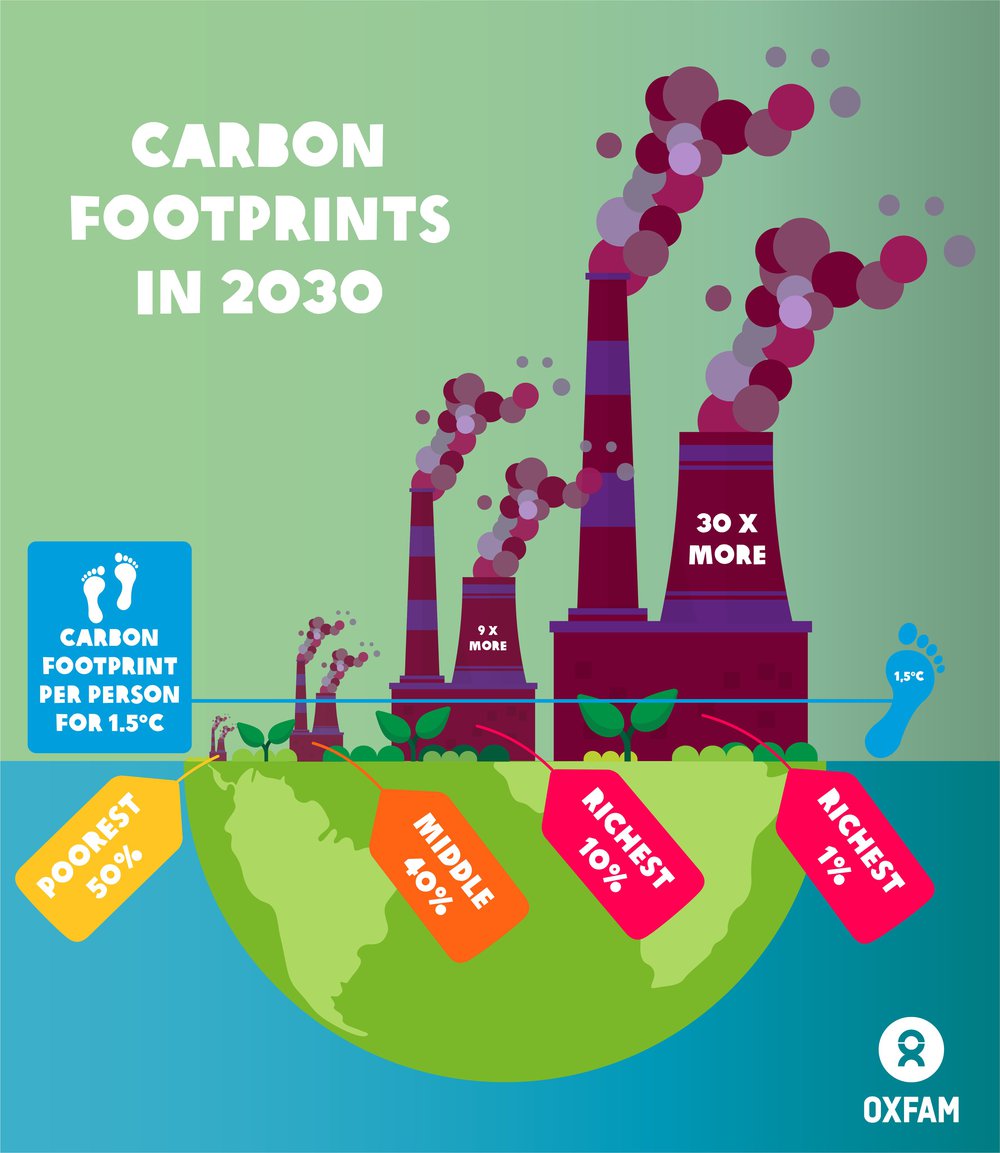
Overconsumption is the real culprit, not overpopulation, as this infographic from OXFAM shows.
Global Distribution of Emissions:
- The richest 10% of the global population produces approximately 50% of all carbon emissions. The poorest 50% produces just 10%. (Oxfam/Stockholm Environment Institute, 2023)
- The average American’s carbon footprint is roughly 15 times larger than the average Indian’s—despite India’s population being four times larger than America’s. (Our World in Data; World Population Review)
- Read more about the infographic here
The Root Cause:
- A landmark analysis published by the National Institutes of Health found that consumption by the world’s wealthiest households is “the strongest accelerator” of ecological degradation. (National Institutes of Health, 2020) The study stresses that current environmental mitigation strategies neglect overconsumption from affluent citizens as the primary driver of unsustainability.
The Scale of Waste:
- Roughly “[T]wenty percent of the world’s population consumes resources at a rate that robs the poor nations and future generations of what they need to survive.” (Pope Francis, 95)
- “We know that approximately a third of all food produced is discarded.” (Pope Francis, 50)
In other words, a smaller but wealthier population can inflict far greater environmental damage than a larger but poorer one. Rising affluence, not rising birth rates, drives the greatest environmental pressures.
A Moral Inversion
This brings us to a profound moral inversion at the heart of population alarmism:
“Is it not simply a new form of war when some nations try to impose restrictive demographic policies on others so that the latter may not claim their just share of the earth’s fruits?” (Pope St. Paul VI, 6)
“To blame population growth instead of extreme and selective consumerism on the part of some, is one way of refusing to face the issues.” (Pope Francis, 50)
The same populations who contribute least to environmental degradation — developing countries — are blamed most, while those who consume the most evade responsibility.
This is not only environmentally wrong; it is morally inverted.
As Pope Benedict XVI taught, “To consider population increase as the primary cause of underdevelopment is mistaken.” (Caritas in Veritate, 44) The true causes are injustice, inequality, and what Pope Francis calls the “throwaway culture”—a consumerist mindset that treats both creation and people as disposable.
The Path to Freedom
Yet Catholic Social Teaching is clear: “It is not wrong to want to live better, what is wrong is a style of life…which wants to have more, not in order to be more but in order to spend life in enjoyment as an end in itself.” (Pope St. John Paul II, 36)
Authentic development serves human flourishing. The Church does not oppose prosperity; it opposes the idolatry that mistakes accumulation for abundance, possession for fulfillment, having for being.
Even in secular development economics, prosperity is no longer defined merely as accumulation. As Amartya Sen famously argued, “Development is not merely the growth of incomes but the expansion of the freedoms that people enjoy.” (from Development as Freedom)
Indeed, affluence without virtue breeds the same despair as poverty without hope.
Summary
What emerges from the data is not merely that the predictions were wrong, but that the question itself was misframed. The prophets of overpopulation asked how many people the planet could sustain. They did not ask what kind of people we are, or what kind of societies we are building. They measured mouths but not minds, consumption but not creativity, pressure but not purpose. In doing so, they reduced a profoundly human and moral question to a technical problem of numbers — and then tried to solve it with technical tools alone.
Once the human person is reduced to a variable, it becomes easy to misdiagnose the crisis and dangerous to prescribe its cure. If people are the problem, then fewer people must be the solution. But if the problem is not population but disorder — in desire, in institutions, in distribution, and in our relationship with creation — then the solution cannot be numerical. It must be moral. It must concern how we live, not how many of us live.
And that realization leads us directly to the real issue the Church has been pointing to all along: not overpopulation, but overconsumption; not too many people, but too little solidarity.
At A Glance
PART 3 — Missing the Real Problem: Consumerism and Overconsumption
What we’ve seen:
- Environmental strain is driven primarily by patterns of consumption, not by population size.
- The wealthy consume disproportionately and contribute most to ecological harm.
- Blaming population growth masks deeper moral and institutional disorders.
What comes next:
- The Church proposes not reduction but reform: a moral vision of development centered on the human person.
Read more about consumerism and overconsumption
Read Part 1: The Malthusian Theory, Paul Ehrlich, and Other Failed Predictions
Read Part 2: Is the World Overpopulated?




CAPP-USA (Centesimus Annus Pro Pontifice, Inc.) is the United States affiliate of the Vatican-based pontifical foundation of Fondazione Centesimus Annus Pro Pontifice, established by Pope St. John Paul II in 1993 to promote Catholic Social Teaching in fidelity to the Magisterium of the Catholic Church. CAPP-USA is a 501(c)(3) nonprofit organization.