Overpopulation
Debunking the Myth with Data and Catholic Social Teaching
The Real Problem is Consumerism
The Predictions Failed
The Solution to More People is More People
Fears Nurtured a Culture of Death
The Prediction that Failed
“Prophets of Doom”
Paul Ehrlich’s “Population Bomb”
For more than half a century, the world has feared that human numbers would overwhelm the planet’s ability to sustain life. Governments and experts warned of famine, resource exhaustion, and ecological collapse. The “population bomb,” they said, was ticking.
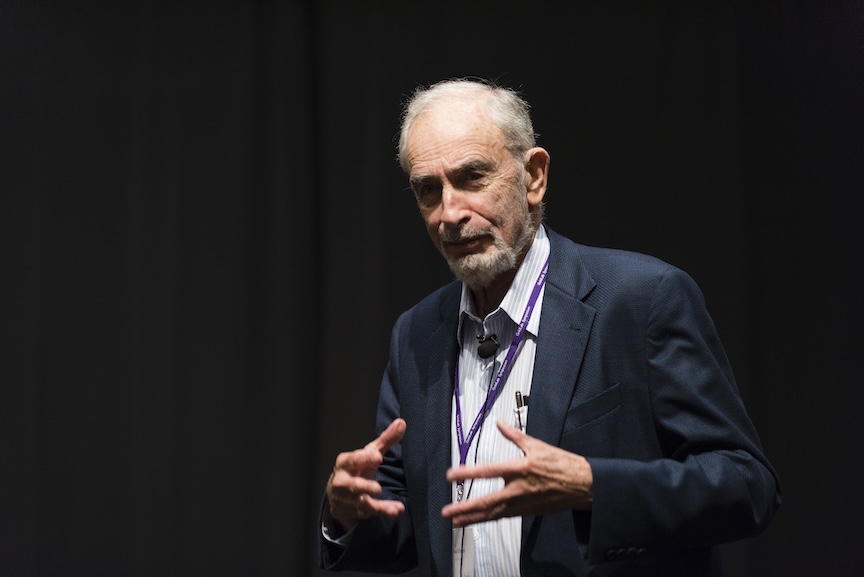
In 1968, biologist Paul Ehrlich made his infamous prediction: “Hundreds of millions of people will starve to death…nothing can prevent a substantial increase in the world death rate.” (Paul Ehrlich, The Population Bomb (New York: Ballantine Books, 1968), p. 11)
He was specific: India, he said, couldn’t possibly feed two hundred million more people by 1980. The battle to feed humanity was over. Mass death was inevitable.
READ MORE
Reality delivered a different verdict. India’s population today exceeds 1.4 billion—over three times larger than Ehrlich’s “impossible” threshold—and Indians are better fed than ever before. Global extreme poverty didn’t increase; it fell by 90% since 1990. (World Bank)
The Club of Rome

Paul Ehrlich wasn’t alone in planting the seeds of overpopulation. In 1972, the Club of Rome issued its influential report Limits to Growth, concluding that if current growth trends continued unchanged, the limits to growth on Earth would be reached sometime within the next one hundred years—by 2072.
The report predicted: “Given present resource consumption rates and the projected increase in these rates, the great majority of currently nonrenewable resources will be extremely expensive 100 years from now.” (Limits to Growth, 1972)
The Malthusian Theory

These predictions rested on a theory first articulated by Thomas Malthus in 1798: that population grows geometrically (2, 4, 8, 16) while food and resources grow only arithmetically (2, 3, 4, 5), leading inevitably to scarcity, famine, and collapse.
The logic seemed airtight. Population had indeed grown rapidly—from 3 billion in 1960 to over 4 billion by 1974. Poverty and hunger were visible across the developing world. Recent memories of wartime scarcity made shortage seem plausible.
But these models made a critical error: they treated humans as merely consumers of resources, never as creators of solutions. They counted mouths to feed but never hands to work or minds to innovate. They saw people as the problem, not as the answer.
What Actually Happened
Several broad and measurable trends show that the global picture looks very different from what mid-twenty century “population alarmists” predicted.
Population Trends: Proving Predictions Wrong
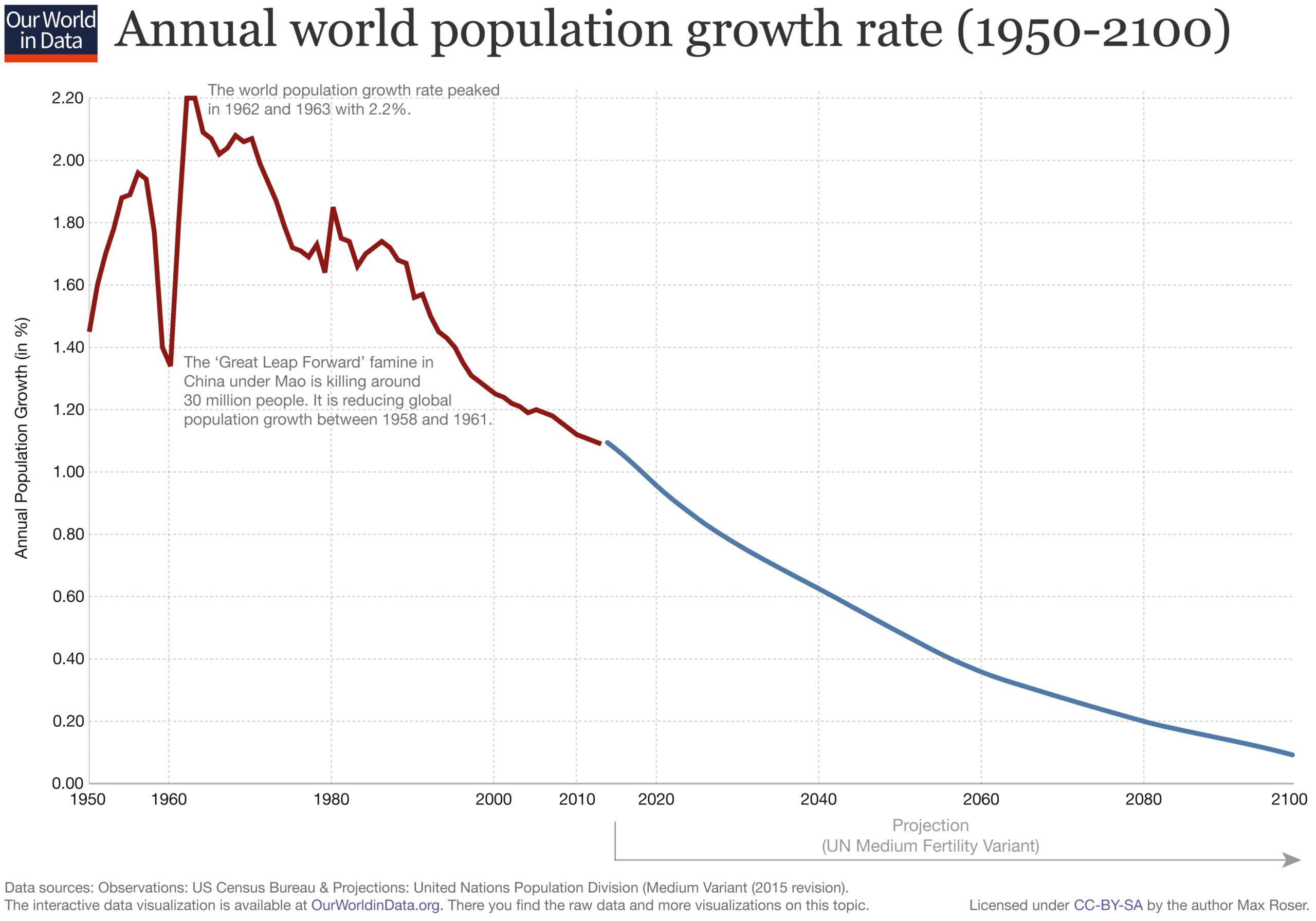
- Declining Fertility Rates: The global fertility rate has fallen dramatically—from about 5 children per woman in 1950 to roughly 2.3 today. Many nations are now below the replacement level of 2.1, signaling a future of slower growth and, in many places, population decline.
- Population Peak and Decline: The global population growth rate continues to slow. According to the United Nations, humanity will likely peak around 2080 at about 10.3 billion before beginning a gradual decline. (World Population Prospects)
- Aging Populations: Falling birth rates and longer lifespans mean aging societies. By the mid-2080s, people aged 65 and older are expected to outnumber children under 18—a reversal without precedent in human history.
Far from an “explosion,” humanity is entering an era of demographic contraction.
Economic Outcomes: Prosperity, Not Poverty

The doomsday forecasts of mass poverty and famine have proven dramatically wrong.
- Rising Incomes. Between 1960 and 2016, the world’s population grew by 145%. (World Bank) Yet over the same period, real average annual per-capita income rose by 183%. (World Bank)
- Declining Poverty. Instead of more poverty, the world experienced the greatest poverty reduction in history. Extreme poverty fell by 90% since 1990. (World Bank) Hundreds of millions were lifted out of extreme deprivation as economies expanded, technology advanced, and human cooperation deepened.
This data tells a profoundly different story: When human creativity is unleashed, population growth can coincide with unprecedented improvements in well-being.
But what about the China challenge—the argument that population control caused prosperity?
The Population Bomb Never Exploded
Was there ever an overpopulation problem?
From the Church’s perspective, the problem was never people themselves. The real question is not how many people the Earth can hold, but how we understand the human person.
As Pope St. John XXIII taught even before the population panic began, God has placed “well-nigh inexhaustible” resources in creation and given humankind the intelligence to develop them responsibly.
Mater et Magistra, 189
Why this Matters
The Stakes
Over the following decades, fear of population growth justified policies that would have been unthinkable in any other context. In India during the mid 1970s, more than 11 million people were sterilized—many under coercion, some at gunpoint. In China, the one-child policy led to forced abortions, abandoned daughters, and a demographic catastrophe still unfolding today. In Peru, indigenous women were sterilized without their knowledge or consent.
These weren’t isolated abuses. They were systematic campaigns, often funded by Western governments and international organizations convinced they were saving the planet.
READ MORE
The Church entered this conversation not as a demographic analyst, but as the guardian of human dignity. As Pope St. Paul VI wrote in 1967, “There is the rapid increase in population which has made many fear that world population is going to grow faster than available resources”. (Humanae Vitae, 2)
The Church insisted on asking a different question: Not “How do we reduce human numbers?” but “How do we build societies that respect every human life?”

The Stakes
This wasn’t merely an academic debate. Ideas have consequences, and the consequences of population alarmism were devastating—particularly for the world’s poor.
Over the following decades, fear of population growth justified policies that would have been unthinkable in any other context. In India during the mid 1970s, more than 11 million people were sterilized—many under coercion, some at gunpoint. In China, the one-child policy led to forced abortions, abandoned daughters, and a demographic catastrophe still unfolding today. In Peru, indigenous women were sterilized without their knowledge or consent.
These weren’t isolated abuses. They were systematic campaigns, often funded by Western governments and international organizations convinced they were saving the planet.
READ MORE
The Church insisted on asking a different question: Not “How do we reduce human numbers?” but “How do we build societies that respect every human life?”
The Last Remaining Argument
“Aren’t Greenhouse Gas Emissions & Climate Change Proof of Overpopulation?”
The nearly doubling of GHG since 1970 has coincided with a global temperature rise of approximately 1.2 °C above pre-industrial levels.

Acknowledging Reality
So, while GHG has markedly increased, is this caused by too many people?
The Catholic Church affirms our responsibility to care for our “common home”. (Environmental Degradation) Terms like “climate action” and “climate justice” are valid—when understood through Catholic Social Teaching. Climate justice, rightly understood, is an act of faith and a work of mercy. It promotes the Common Good.
Pope Francis’s 2015 encyclical Laudato Si’ is among the most urgent and comprehensive treatments of ecological degradation. The Church affirms that care of creation is a moral imperative, not an optional concern.
But diagnosis matters. Is climate change caused by too many people, or by how some people live?
No, Climate Change is Not Proof of Overpopulation
The Real Problem is Consumerism
The Church has long taught that the world’s crisis is not one of numbers but of values. The true imbalance lies not between people and resources, but between excess and want—between those who consume far too much and those who have far too little.
Population alarmism was not merely an error of data—it was a moral failure, rooted in a loss of confidence in the human person and a forgetfulness of God’s providence.
But more fundamentally, it was a misdiagnosis. The prophets of doom blamed the wrong culprit.
What Is Consumerism?
Consumerism, simply but elegantly defined, is: A style of life directed towards “having” rather than “being.” It is a “web of false and superficial gratifications.” (Pope St. John Paul II, 41)
It is a mindset where “the acquisition of worldly goods can lead men to greed, to the unrelenting desire for more.” (Pope St. Paul VI, 18) This “exclusive pursuit of material possessions prevents man’s growth as a human being and stands in opposition to his true grandeur. Avarice, in individuals and in nations, is the most obvious form of stultified moral development. (Pope St. Paul VI, 19)
A person who is concerned solely or primarily with possessing and enjoying—who can no longer subordinate his instincts—cannot be free
READ MORE
When we mistake consumption for fulfillment, we create a double crisis: spiritual poverty among the affluent, and material deprivation among the poor.
The Data Are Clear
Studies consistently show that the affluent are responsible for a disproportionate share of global environmental harm.

The Real Problem is Consumerism
The Church has long taught that the world’s crisis is not one of numbers but of values. The true imbalance lies not between people and resources, but between excess and want—between those who consume far too much and those who have far too little.
Population alarmism was not merely an error of data—it was a moral failure, rooted in a loss of confidence in the human person and a forgetfulness of God’s providence.
But more fundamentally, it was a misdiagnosis. The prophets of doom blamed the wrong culprit.
What Is Consumerism?
Consumerism, simply but elegantly defined, is: A style of life directed towards “having” rather than “being.” It is a “web of false and superficial gratifications.” (Pope St. John Paul II, 41)
It is a mindset where “the acquisition of worldly goods can lead men to greed, to the unrelenting desire for more.” (Pope St. Paul VI, 18) This “exclusive pursuit of material possessions prevents man’s growth as a human being and stands in opposition to his true grandeur. Avarice, in individuals and in nations, is the most obvious form of stultified moral development. (Pope St. Paul VI, 19)
A person who is concerned solely or primarily with possessing and enjoying—who can no longer subordinate his instincts—cannot be free.
READ MORE
When we mistake consumption for fulfillment, we create a double crisis: spiritual poverty among the affluent, and material deprivation among the poor.
The Data Are Clear
Studies consistently show that the affluent are responsible for a disproportionate share of global environmental harm.
Why the “Experts” Were So Wrong
Having examined what actually happened, we must now ask:
Why did the experts get it so wrong? And what does their error teach us about human nature and creativity?
Innovation Outpaced Growth

Remember that Paul Ehrlich, the Club of Rome, and alarmists predicted that population growth would rapidly deplete natural resources? “Given present resource consumption rates and the projected increase in these rates, the great majority of currently nonrenewable resources will be extremely expensive 100 years from now.” (Limits to Growth)
The opposite has occurred.
Food Production: Global calories per person rose 30% since 1968. The famines Ehrlich predicted never materialized. The Green Revolution—through improved seeds, irrigation, and farming techniques—allowed food production to outpace population growth, preventing the mass starvation once deemed “inevitable.”
Resource Prices: Most commodities tracked by the World Bank are cheaper today—either in absolute terms or relative to income. (World Bank) Prices, which reflect scarcity, have generally declined, suggesting that human ingenuity and market adaptation have outpaced depletion.
The Pattern of Innovation: When resources grow scarce, prices rise—and people respond. Consider whale oil: in the 1800s, it was the primary fuel for lamps. As whales grew scarce and prices rose, we didn’t run out of light. Instead, we discovered kerosene, then invented electric lighting. Today, LED bulbs use 90% less energy than their predecessors.
The Predictions Underestimated Us
The failed predictions of overpopulation and collapse stemmed from flawed models — and from a deeper misunderstanding of the human person.
The error of the Malthusian Theory: Most 20th-century population models were extensions of Thomas Malthus’s 1798 theory that population grows geometrically while food and resources grow only arithmetically, leading inevitably to scarcity and famine.
But these models failed to anticipate what the Church had already articulated: that human beings are not passive consumers of resources, but active co-creators.
As Pope St. John XXIII proclaimed in 1961: “The resources which God in His goodness and wisdom has implanted in nature are well-nigh inexhaustible, and He has at the same time given man the intelligence to discover ways and means of exploiting these resources for his own advantage and his own livelihood.” (Mater et Magistra, 189)
In other words, the central variable the models missed was human creativity — our God-given ability to learn, innovate, and collaborate.
READ MORE
Human Participation in Creation: Pope St. John Paul II later deepened this insight: “Man, created in the image of God, participates by his work in the work of the Creator, and continues…to develop and complete it.” (Laborem Exercens, 25)
When we recognize work, technology, and enterprise as forms of cooperation with God’s providence, we understand why the predictions of exhaustion and collapse failed. Human development is not automatic — but neither is it doomed. It depends on virtue, responsibility, and hope.
Attention! This is the Fundamental Takeaway!
A Moral Inversion
This brings us to a profound moral inversion at the heart of population alarmism:
“Is it not simply a new form of war when some nations try to impose restrictive demographic policies on others so that the latter may not claim their just share of the earth’s fruits?” (Pope St. Paul VI, 6)
“To blame population growth instead of extreme and selective consumerism on the part of some, is one way of refusing to face the issues.” (Pope Francis, 50)
The same populations who contribute least to environmental degradation— developing countries —are blamed most, while those who consume the most evade responsibility. This is not only environmentally wrong; it is morally obscene.
As Pope Benedict XVI taught, “To consider population increase as the primary cause of underdevelopment is mistaken.” (Caritas in Veritate, 44) The true causes are injustice, inequality, and what Pope Francis calls the “throwaway culture”—a consumerist mindset that treats both creation and people as disposable.

A Moral Inversion
This brings us to a profound moral inversion at the heart of population alarmism:
“Is it not simply a new form of war when some nations try to impose restrictive demographic policies on others so that the latter may not claim their just share of the earth’s fruits?” (Pope St. Paul VI, 6)
“To blame population growth instead of extreme and selective consumerism on the part of some, is one way of refusing to face the issues.” (Pope Francis, 50)
The same populations who contribute least to environmental degradation— developing countries —are blamed most, while those who consume the most evade responsibility. This is not only environmentally wrong; it is morally obscene.
As Pope Benedict XVI taught, “To consider population increase as the primary cause of underdevelopment is mistaken.” (Caritas in Veritate, 44) The true causes are injustice, inequality, and what Pope Francis calls the “throwaway culture”—a consumerist mindset that treats both creation and people as disposable.
The Damage Done by Overpopulation Alarmism
When Fear Replaces Faith
Ideas have consequences. When fear replaces faith in the human person, policies often follow that deny the very dignity they claim to protect.
The population alarmism of the late 20th century helped justify what Pope St. John Paul II called a “culture of death”—in which abortion, sterilization, and contraception were promoted not as choices or healthcare, but as moral necessities to “save the planet.” The result was widespread harm—especially to the poor and vulnerable.

A Culture of Death
As mentioned, even in 1961, before the population panic reached its height, Pope St. John XXIII foresaw the danger and offered a prophetic warning: “No statement of the problem and no solution to it is acceptable which does violence to man’s essential dignity”. (Mater et Magistra, 191)
But as fear spread, coercive policies became common:
- Forced Sterilizations: In India (1975–77), more than 11 million people were sterilized, many under duress or without consent. Similar programs were later carried out in Peru.
- China’s One-Child Policy: Enforced abortions and sterilizations became state policy for decades, justified globally by the same Malthusian fears.
- Western Funding of Coercion: Development aid from wealthy nations and international agencies often tied assistance to family-planning quotas, enabling coercive practices at the local level. (Cato Institute)
The Church’s voice was clear and consistent in condemning these abuses:
READ MORE
“[W]ith time the threats against life have not grown weaker…no, they are scientifically and systematically programmed threats.” (Pope St. John Paul II, 17)
“Thus an anti-life mentality is born, as can be seen in many current issues: one thinks, for example, of a certain panic deriving from the studies of ecologists and futurologists on population growth, which sometimes exaggerate the danger of demographic increase to the quality of life.” (Pope St. John Paul II, 30)
Yet, in the face of population growth and demographic shifts, “instead of resolving the problems of the poor and thinking of how the world can be different, some can only propose a reduction in the birth rate.” (Pope Francis, 50)
In these words, the Popes exposed the moral inversion at work: the poor were treated not as persons to be assisted, but as numbers to be reduced.
Overpopulation is a Profound Misdiagnosis
Pope St. John Paul II warned us that, “Today not a few of the powerful of the earth…are haunted by the current demographic growth, and fear that the most prolific and poorest peoples represent a threat for the well-being and peace of their own countries.” (Evangelium Vitae, 16)
As Pope Benedict XVI explained, “To consider population increase as the primary cause of underdevelopment is mistaken.” (Caritas in Veritate, 44)
Pope Francis made the same point with piercing simplicity: “Instead of resolving the problems of the poor and thinking of how the world can be different, some can only propose a reduction in the birth rate.” (Laudato Si, 50)
Population alarmism was not merely an error of data — it was a moral failure, rooted in a loss of confidence in the human person and a forgetfulness of God’s providence.
The programs of population control, pursued for decades, brings us to the heart of the matter.
READ MORE
The true source of poverty lies not in the number of people, but in a failure of justice: economic systems that value money over people; greed that prevents the equitable sharing of creation’s goods; conflict and political instability; poor governance and corruption; discrimination and exclusion. These causes, and others, often interact to create a cycle of poverty that is difficult to break.

Overpopulation is a Profound Misdiagnosis
Pope St. John Paul II warned us that, “Today not a few of the powerful of the earth…are haunted by the current demographic growth, and fear that the most prolific and poorest peoples represent a threat for the well-being and peace of their own countries.” (Evangelium Vitae, 16)
As Pope Benedict XVI explained, “To consider population increase as the primary cause of underdevelopment is mistaken.” (Caritas in Veritate, 44)
Pope Francis made the same point with piercing simplicity: “Instead of resolving the problems of the poor and thinking of how the world can be different, some can only propose a reduction in the birth rate.” (Laudato Si, 50)
Population alarmism was not merely an error of data — it was a moral failure, rooted in a loss of confidence in the human person and a forgetfulness of God’s providence.
The programs of population control, pursued for decades, brings us to the heart of the matter.
READ MORE
The true source of poverty lies not in the number of people, but in a failure of justice: economic systems that value money over people; greed that prevents the equitable sharing of creation’s goods; conflict and political instability; poor governance and corruption; discrimination and exclusion. These causes, and others, often interact to create a cycle of poverty that is difficult to break.
The Real Remedy: Integral Human Development
Economic growth (and environmental care) must serve the good of the whole person and of every person. When consumption becomes detached from moral responsibility, it turns into idolatry—the “throwaway culture” Pope Francis describes.
Renewed Anthropology

The Church calls instead for a renewed anthropology: one that sees every human life as a gift, every resource as entrusted, and every society as responsible for the common good.
This is not merely abstract theology. It demands concrete transformation:
- From Fear to Stewardship: The question is not “How do we have fewer people?” but “How do we build societies where prosperity serves dignity, where consumption honors creation, where having supports being?”
- From Restriction to Responsibility: We don’t need to limit births in poor nations—we need to limit excess in wealthy ones. We don’t need population control—we need consumption reform.
- From Zero-Sum to Solidarity: When resources are justly shared and creativity is unleashed, abundance becomes possible. The problem isn’t that there are too many people sharing the pie; it’s that some take far more than their share while others go hungry.
Is 10 Billion People Sustainable?

This is the right question. And the answer is: Yes—if we organize society justly.
Understanding the real problem—consumerism rather than population—points us toward the real solution: not managing human numbers, but transforming human hearts and reforming human systems.
Human ingenuity has already demonstrated extraordinary capacity for adaptation.
But technology alone is insufficient to solving the GHG issue. Pope Benedict XVI reminds us that while technology can “enable us to exercise responsible stewardship over nature” (Caritas in Veritate, 50)—this is true only when guided by moral purpose.
Population and climate are related—but the relationship runs through consumption patterns, not human numbers.
The Choice Before Us

The solution lies in transforming how we live, not in reducing how many of us live.
As Pope Francis teaches, the solution is not fewer people but different priorities. Not restriction but reformation. Not fear but faith in humanity’s God-given capacity to build a world worthy of our calling.
This is the path forward the Church offers: not fear and restriction, but hope and responsibility. Not fewer people, but better stewardship. Not managing scarcity, but building solidarity.
So, the question isn’t whether Earth can sustain 10 billion people. The question is whether 10 billion people can learn to live sustainably—with justice, solidarity, and care for our common home.
History suggests we can. The data shows the path. The choice is ours.

The Ultimate Resource: The Human Mind
Economist Julian Simon famously argued that the human intellect—capable of innovation, substitution, and stewardship—is the “ultimate resource.” (Julian L. Simon, The Ultimate Resource 2, Rev. ed. (Princeton, NJ: Princeton University Press, 1998)
This illustrates a profound theological point: when human freedom is joined to moral purpose, innovation becomes a form of stewardship—a way of cooperating with God’s providence to make creation fruitful for all.
As Pope St. John Paul II taught, “Man, created in the image of God, participates by his work in the work of the Creator, and continues…to develop and complete it.” (Laborem Exercens, 25)
But what about pollution and environmental degradation? Here the picture becomes more complex—and demands our careful attention.
The 2072 Question Revisited
Despite these shifting demographic realities, the fundamental question remains. In 1972, the Club of Rome gave humanity a deadline: 2072, when the ‘limits to growth’ would be reached. We’re now 47 years from that reckoning. Will humanity navigate the challenges of climate change, demographic shifts, resource pressures, and technological disruption?
The evidence of the past 52 years provides an answer: We’re not just surviving—we’re thriving.
Not through luck, but through the pattern the Church predicted: when people are educated, empowered, and treated with dignity, they respond to challenges with creativity that transforms scarcity into abundance.
Extreme poverty has fallen 90%. Life expectancy has doubled in many nations. Literacy has soared. The famines never came.
Yet the question remains: Will this continue? The answer depends on whether we choose fear or faith.”
As Gaudium et Spes proclaimed, “The future of humanity is in the hands of those who can give future generations reasons for life and hope.” (Gaudium et Spes, 31)

This is the Church’s enduring wisdom: that people aren’t the problem. People are the answer.
Despite these shifting demographic realities, the fundamental question remains. In 1972, the Club of Rome gave humanity a deadline: 2072, when the ‘limits to growth’ would be reached. We’re now 47 years from that reckoning. Will humanity navigate the challenges of climate change, demographic shifts, resource pressures, and technological disruption?
The evidence of the past 52 years provides an answer: We’re not just surviving—we’re thriving.
Not through luck, but through the pattern the Church predicted: when people are educated, empowered, and treated with dignity, they respond to challenges with creativity that transforms scarcity into abundance.
Extreme poverty has fallen 90%. Life expectancy has doubled in many nations. Literacy has soared. The famines never came.
Yet the question remains: Will this continue? The answer depends on whether we choose fear or faith.”
As Gaudium et Spes proclaimed, “The future of humanity is in the hands of those who can give future generations reasons for life and hope.” (Gaudium et Spes, 31)
This is the Church’s enduring wisdom: that people aren’t the problem. People are the answer.
The New Challenge
Demographic Decline
While much of the 20th century worried about too many people, the 21st century faces the opposite problem: too few.
The Coming Contraction

The demographic reality is stark:
- Japan, Italy, and South Korea are already experiencing population decline, with devastating effects on their economies and societies.
- China will lose an estimated 800 million people by 2100. (U.N.)
- Europe faces a similar trajectory, with many nations seeing more deaths than births each year.
By the mid-2080s, people aged 65 and older are expected to outnumber children under 18 globally—a reversal without precedent in human history.
Why This Matters

The economic and social challenges are profound:
- Pension systems designed for growing populations are breaking under the strain of fewer workers supporting more retirees.
- Innovation depends disproportionately on young, dynamic populations willing to take risks and challenge convention.
- Elder care becomes an overwhelming burden as the ratio of working-age adults to seniors plummets.
- Cultural continuity frays when communities lack the children who carry forward traditions, languages, and social bonds.
The panic over “too many people” gave way, almost overnight, to anxiety about “too few.” Yet the same nations that once funded population control programs now desperately incentivize childbearing—with little success.

In Summary
Like so many dystopian predictions—and utopian promises—before and after, the theory that human population growth would exceed Earth’s carrying capacity has proven wrong.
The population bomb never exploded because it was never real, as demonstrated by the fact that India now feeds 1.4 billion people—a feat Paul Ehrlich once deemed impossible. The limits to growth were not reached.
The prophets of doom fundamentally misunderstood the ultimate resource: the human person, created in God’s image, capable of innovation, cooperation, and stewardship. Human beings are not merely mouths to feed; we are minds that innovate, hands that build, and hearts that cooperate. The alarmists counted people and saw a problem. The Church sees persons and recognizes a promise.
The choice—as it always has been—is ours.
May we choose wisely. May we choose life. May we choose the path that honors both the dignity of every human person and the care of our common home.
For when we do, we discover what the Church has taught for millennia and what the data now confirm: that people are not the burden we feared, but the blessing we needed all along.
Catholic Social Teaching and Other Issues
The Church calls us to approach these issues with a “renewed confidence in the human person.”
Pope St. John Paul II, 6

























Why These Issues Matter
Catholic social teaching informs our consciences and requires action from us, the lay faithful. “Working for a just distribution of the fruits of the earth and human labor is not mere philanthropy. It is a moral obligation.
For Christians, the responsibility is even greater: it is a commandment.”




CAPP-USA (Centesimus Annus Pro Pontifice, Inc.) is the United States affiliate of the Vatican-based pontifical foundation of Fondazione Centesimus Annus Pro Pontifice, established by Pope St. John Paul II in 1993 to promote Catholic Social Teaching in fidelity to the Magisterium of the Catholic Church. CAPP-USA is a 501(c)(3) nonprofit organization.