What is the Responsibility of a Catholic Politician?
by CAPP-USA
Updated September 2026
Catholic politicians are called to serve the common good, protect human dignity, form their consciences according to Catholic teaching, and bring their moral convictions into public life without turning the Church into a political party. They are not required to support one political party or one detailed policy program, but neither may they treat fundamental moral principles as irrelevant once they enter public office.
Catholic politicians have a special responsibility.
They are not called simply to win elections, advance a party platform, or follow public opinion.
Catholic politicians are called to exercise public authority in service of the human person and the common good.
That responsibility begins with a properly formed conscience and “a well-formed Christian conscience does not permit one to vote for a political program or an individual law which contradicts the fundamental contents of faith and morals”. (Doctrinal Note on the Participation of Catholics in Political Life, 3)
A Catholic in public life “cannot think of delegating his Christian responsibility to others.” (Doctrinal Note on the Participation of Catholics in Political Life, 3)
In proclaiming Saint Thomas More ‘Patron of statesmen and politicians’ – More was martyred for refusing to bend his conscience to political pressure – Pope St. John Paul II noted that what guided More, was the conviction that “man cannot be sundered from God, nor politics from morality.” (Motu Proprio, October 31, 2000, 4)
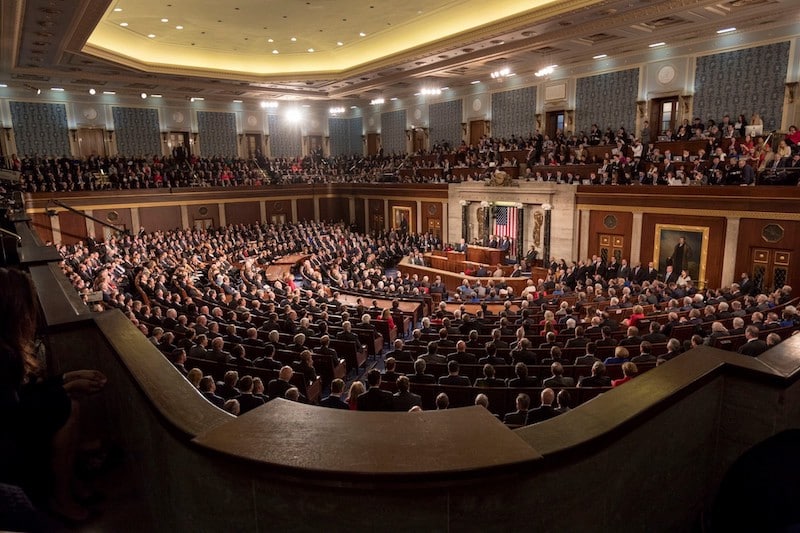
Catholic politicians have a responsibility to courageously promote the Truth
Are Catholics Required to Participate in Politics?
The obligation to participate in politics is, itself, part of the Catholic vocation.
“We, Christians, cannot ‘play Pilate’ and wash our hands…We must participate in politics because politics is one of the highest forms of charity because it seeks the common good.” (Pope Francis)
Pope Leo XIV made the same point and directed our attention to how early on the Church spoke to it.
In addressing legislators from 68 countries he repeated that “Politics has rightly been defined as ‘the highest form of charity’ quoting Pope Pius XI (Address to the Italian Catholic University Federation, December 18, 1927).”
“Indeed, if we consider the service that political life renders to society and to the common good, it can truly be seen as an act of Christian love, which is never simply a theory, but always a concrete sign and witness of God’s constant concern for the good of our human family (cf. Francis, Encyclical Letter Fratelli Tutti, 176-192).” (Address to the Inter-Parliamentary Union)
What Is the Political Responsibility of a Catholic?
Pope Benedict XVI called politicians and legislators “servants of the common good” and he placed a particular responsibility on Catholic legislators: (Address, December 3, 2005)
“Catholic politicians and legislators, conscious of their grave responsibility before society, must feel particularly bound…to introduce and support laws inspired by values grounded in human nature.” (Pope Benedict XVI, 83)
Pope Francis put the same demand more bluntly: “good politics is possible, indeed dutiful” when it “puts the human person and the common good at the center.” Promoting the common good, he said, bears particular weight on “those who assume social and political commitments and positions.” (General Audience, September 9, 2020)
“To build a healthy, inclusive, just and peaceful society we must do so on the rock of the common good. The common good is a rock.” (General Audience, September 9, 2020)
Pope Leo XIV brought this point into the present day when he said that the principles of Catholic Social Doctrine — “the inviolable dignity of every person, the common good, the universal destination of goods, subsidiarity and solidarity – provide the sure criteria for discernment.” (Address to the International Catholic Legislators Network)
Addressing the challenge of artificial intelligence, he added that sound legislation should protect people from exploitation, preserve privacy, ensure transparency, and strengthen democratic institutions.
He went on to describe the common good as “the social expression” of human dignity.
The question for a Catholic politician, then, is not merely: What can I legally do?
It is also: What ought I to do for the good of the human person and society?
Catholic Politicians and the Right to Life
Some moral questions impose especially clear responsibilities on lawmakers.
Abortion is one of them.
Pope Benedict XVI taught that public officials “are duty bound to defend the fundamental right to life.” (Address, December 3, 2005)
Pope Pius XI likewise wrote: “Those who hold the reins of government should not forget that it is the duty of public authority by appropriate laws and sanctions to defend the lives of the innocent…in the first place infants hidden in the mother’s womb.” (Casti Connubii, 67)
And Pope St. John Paul II was explicit: “No one can ever renounce this responsibility, especially when he or she has a legislative or decision-making mandate.” (Evangelium Vitae, 90)
The Church therefore does not treat abortion merely as one policy preference among many.
Pope Leo XIV reinforced this in the strongest terms.
Drawing on Magnifica Humanitas, he told Spanish lawmakers that “every human life must be recognized and safeguarded from conception to its natural end, in every circumstance of its existence”.
He went on to warn that “when this certainty is obscured, the most vulnerable are the first victims, and the law loses its deepest meaning.”
The defense of human life is “neither a partisan issue nor a confessional interest” but “a goal of civilization.” (Meeting with members of the Spanish Parliament)
At the same time, Catholic moral teaching recognizes that legislators sometimes operate in imperfect political circumstances.
When Can Catholic Politicians Legitimately Disagree?
The Church distinguishes between abandoning a fundamental moral principle and making prudential judgments about how best to advance that principle under real-world conditions. (Doctrinal Note on the Participation of Catholics in Political Life)
Catholic politicians are not required to reach identical conclusions on every public-policy question. The Church recognizes a legitimate plurality of political approaches. That plurality concerns the choice of morally acceptable means, not the abandonment of essential moral principles.
Catholics may honestly disagree over tax rates, regulatory structures, health-care systems, environmental mechanisms, immigration administration, anti-poverty programs, education policy, defense spending, and many other questions of means.
Why? Because Catholic Social Teaching provides moral principles, not detailed legislative programs.
The Church’s doctrinal note explicitly recognizes that political life often involves different strategies, technical assessments, and contingent judgments, allowing for a legitimate plurality of morally acceptable solutions.
But prudential disagreement is not the same thing as moral relativism. Some principles are not simply negotiable political preferences.
Human dignity does not depend on a vote. The deliberate killing of innocent human life cannot become morally good because a majority approves it. Nor can Catholics simply dismiss the dignity of workers, the poor, migrants, families, the elderly, the disabled, or other vulnerable people because their protection is politically inconvenient.
The challenge is to distinguish carefully between the principle itself and the prudential means of applying it.
Catholic Responsibility Extends Beyond One Issue
The obligation of moral coherence does not begin and end with abortion.
Catholic politicians must take seriously the Church’s teaching on:
- the dignity of every human person
- marriage and family
- religious freedom
- the dignity of work
- the rights of workers
- private property and its social obligations
- care for creation
- immigration
- poverty
- peace
- solidarity
- subsidiarity
- the preferential option for the poor
Pope Leo XIV touched on nearly all of these in a single speech — urging protection for migrants, support for families, a preference for peace over rearmament, and robust ethical oversight of artificial intelligence, alongside his appeal on life. (Meeting with members of the Spanish Parliament)
But these teachings do not all translate into public policy in precisely the same way. Some concern fundamental moral prohibitions. Others establish goals or principles while leaving considerable room for disagreement about the best legislative means.
That is why Catholic Social Teaching cannot simply be mapped onto the platform of either major political party.
The purpose of Catholic Social Teaching is not to baptize our politics but to judge and reshape them. (Catholic Social Teaching is not Liberal or Conservative)
Can a Catholic Politician Separate Personal Faith From Public Office?
Not completely.
The Church recognizes the legitimate autonomy of political institutions. Catholic politicians are not supposed to impose uniquely theological beliefs simply because the Church teaches them.
But neither does the Church accept the idea that faith and moral conviction must disappear when a Catholic enters public office.
The Church’s doctrinal note makes an important distinction: the proper autonomy of political life means independence from ecclesiastical control; it does not mean independence from morality.
Pope Benedict XVI warned: “Any tendency to treat religion as a private matter must be resisted.” (Address to the Bishops of the United States of America)
The point is not that every article of Catholic doctrine should become civil law. Rather, the Catholic politician cannot divide life into two unrelated compartments — Catholic convictions on Sunday and morally neutral decision-making the rest of the week.
Public decisions inevitably rest on some understanding of the human person, justice, rights, and the common good. “[E]very legislative task ultimately confronts a decisive question: what conception of the human person inspires laws, and what kind of society do those laws build?” (Pope Leo XIV)
That is the Catholic political question in its most fundamental form.
Does the Catholic Church Have a Political Party?
There is no Catholic political party. Catholic Social Teaching is not Democratic or Republican, liberal or conservative: “there can generally be a plurality of political parties in which Catholics may exercise… their right and duty to contribute to the public life of their country”.
But there is an obligation: this “should not be confused… with an ambiguous pluralism in the choice of moral principles or essential values.” (Doctrinal Note on the Participation of Catholics in Political Life)
Pope St. John Paul II made this clear in declaring Saint Thomas More Patron of Statesmen and Politicians, pointing to his martyrdom for refusing to let political loyalty override “the primacy of truth over power.” (Motu Proprio, October 31, 2000, 1)
For Catholics in public office, party discipline therefore cannot become the ultimate moral standard. Neither can personal ambition, polling, or political convenience.
The first loyalty is to truth about the human person and the common good.
Pope Francis warned against exactly this temptation. He saw “partisan interests emerging” — people “seeking economic or political advantages, generating or exacerbating conflicts” instead of “working toward a good shared by all.” (General Audience, September 9, 2020)
“Those who simply look past others’ suffering to protect their own position, he said, are “devotees of Pontius Pilate: they wash their hands” (General Audience, September 9, 2020) — the same image he had used years earlier to describe Catholics who refuse to engage in politics at all.
Withdrawing from politics and weaponizing it for partisan gain turn out to be two forms of the same failure: both, in their own way, wash their hands of the common good.
What Is the Church’s Role in Politics?
The Church does not claim to provide technical solutions to every political problem.
As Pope Benedict XVI wrote: “The Church does not have technical solutions to offer and does not claim ‘to interfere in any way in the politics of States.’” — (Caritas in Veritate, 9)
The Church’s role is different. She teaches moral principles, helps form consciences, and reminds political society that government exists for the human person — not the other way around.
“It is not the Church’s task to set forth specific political solutions… to temporal questions that God has left to the free and responsible judgment of each person.” Its purpose, rather, is “to instruct and illuminate the consciences of the faithful.” (Doctrinal Note on the Participation of Catholics in Political Life)
The Church therefore does not become another political party. Her task is to form consciences and teach the moral principles by which political choices should be judged.
What Does the Catholic Church Teach About Democracy?
The Church values democratic participation because it allows citizens to take responsibility for public life.
But democracy is not simply majority rule.
Pope St. John Paul II warned that: “Authentic democracy is possible only in a State ruled by law, and on the basis of a correct conception of the human person.” (Centesimus Annus, 46)
Pope Leo XIV has expressed the same principle: “[E]very truly just society is built upon the recognition of the inviolable dignity of the human person,” a dignity that “precedes any concession by the state and cannot be subordinated to shifting social consensus or the whims of the majority at any given moment.” (Meeting with members of the Spanish Parliament)
So Catholic political responsibility begins deeper than legislation. It begins with anthropology: Who is the human person?
If that answer is wrong, political structures eventually go wrong with it.
Bottom Line
Catholic politicians are not called to impose a Catholic political program.
They are called to exercise public responsibility with a well-formed conscience, to protect the dignity of the human person, to pursue the common good, and to resist allowing party loyalty, ideology, or political convenience to override fundamental moral truths.
On many public-policy questions, faithful Catholics may legitimately disagree about the best means. But they cannot simply declare moral truth irrelevant because they have entered politics.
Pope Leo XIV has repeatedly returned to the same foundational principles: human dignity, the common good, subsidiarity and solidarity.
The task is not to make Catholic Social Teaching conform to our politics. It is to allow Catholic Social Teaching to form our consciences — and then bring those consciences into public life.
Conversion of Heart and Soul
Pope St. John Paul II wrote: “Truth and freedom either go together hand in hand or together they perish in misery.” (Fides et Ratio, 90)
And Pope Benedict XVI reminded Americans that freedom “demands the courage to engage in civic life and to bring one’s deepest beliefs and values to reasoned public debate”. (Address at the White House)
Ultimately, Catholic political renewal requires more than better policies. It calls for “a conversion of heart and soul.” That applies to politicians — and to those who elect them.
Read more about: the Common Good, Human Dignity, Solidarity, and Subsidiarity
Frequently Asked Questions
Q: Does the Catholic Church tell Catholic politicians how to vote?
A: Not on every political question. The Church teaches fundamental moral principles and helps Catholics form their consciences. Many policy questions involve prudential judgments about how those principles should best be applied. As the Doctrinal Note puts it, “it is not the Church’s task to set forth specific political solutions… to temporal questions that God has left to the free and responsible judgment of each person.”
Q: Can Catholic politicians disagree with Church teaching?
A: Catholic politicians, like all Catholics, have a responsibility to form their consciences in accord with moral truth and the teaching of the Church. There can be legitimate disagreement over how principles are best implemented through particular policies and legislative means. But disagreement over policy means is different from rejecting a fundamental moral principle itself.
Q: Can faithful Catholics disagree about public policy?
A: Yes. The Church recognizes legitimate political pluralism and allows considerable room for prudential judgment about policy mechanisms, strategies, and priorities.
Q: Can a Catholic politician keep his or her faith private?
A: Catholic politicians must respect the legitimate autonomy of civil government and may not simply impose religious doctrine as law. But the Church rejects the idea that moral conviction must be excluded from public life. Political decisions necessarily involve judgments about justice, human dignity, and the common good.
Q: Does the Catholic Church endorse a political party?
A: No. The Church does not identify herself with a political party. The Doctrinal Note recognizes a legitimate plurality of parties while insisting this “should not be confused… with an ambiguous pluralism in the choice of moral principles or essential values.”
Q: What is a properly formed conscience?
A: A properly formed conscience is not simply personal preference or feeling. The Second Vatican Council describes conscience as “the most intimate centre and sanctuary of a person, in which he or she is alone with God, whose voice echoes within them” (Gaudium et Spes, 16), and the Doctrinal Note teaches that a well-formed Christian conscience must be shaped by truth and by the teaching of the Church.
Q: What principles should guide Catholic politicians?
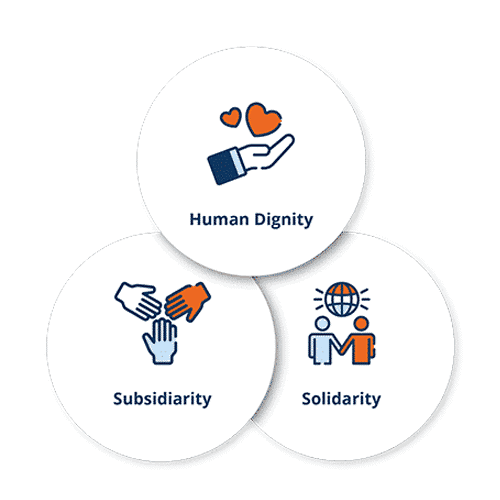
A: The central principles of Catholic Social Teaching include human dignity, solidarity, subsidiarity, and the outcome of these three principles, the common good. Pope Leo XIV presented these principles explicitly to Catholic legislators in August 2026 as criteria for political discernment.



CAPP-USA (Centesimus Annus Pro Pontifice, Inc.) is the United States affiliate of the Vatican-based pontifical foundation of Fondazione Centesimus Annus Pro Pontifice, established by Pope St. John Paul II in 1993 to promote Catholic Social Teaching in fidelity to the Magisterium of the Catholic Church. CAPP-USA is a 501(c)(3) nonprofit organization.