The Gig Economy and Rerum Novarum: The Moral Principles 2026 Cannot Ignore
by CAPP-USA
Is the gig economy new?
In 1891, Rerum Novarum addressed a remarkably similar labor crisis.
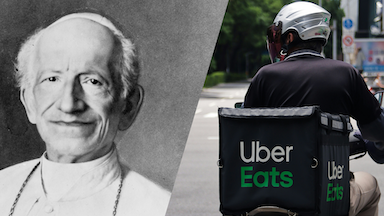
Rerum Novarum ushered Catholic social teaching into the modern age, and applies to the gig economy.
According to 2026 labor reporting from SHRM, more than 70% of workers now rely on secondary gig income to meet daily expenses. Platform-based work, freelance contracts, and digital labor markets are reshaping how millions earn a living — often outside traditional employment structures and without portable benefits.
What do Uber drivers and 19th-century factory workers have in common?
Precarious wages. Uncertain protections. A growing temptation to treat labor as just another commodity.
When work becomes detached from stability, family life, and long-term responsibility, something essential is lost.
In 1891, amid the sweeping disruptions of the Industrial Revolution, Pope Leo XIII confronted this reality directly in Rerum Novarum describing “the misery and wretchedness pressing so unjustly on the majority of the working classes”. (Rerum Novarum, 3)
Factories replaced farms. Families were uprooted. Wealth concentrated. Ideologies promised liberation through either unchecked markets or sweeping state control.
Pope Leo XIII rejected both.
Instead, he articulated a demanding principle: the human person must remain at the center of economic life.
More than a century later, as independent contractors navigate digital platforms and fragmented labor markets, that principle remains urgent:
Work is not a commodity. It is an expression of human dignity.
What Is the Gig Economy?
The gig economy refers to labor arrangements in which workers earn income through short-term contracts, freelance work, or digital platforms rather than traditional full-time employment. These structures include app-based drivers, freelance professionals, and platform workers operating as independent contractors in rapidly evolving digital labor markets.
Rerum Novarum and the Origins of Catholic Social Teaching
The encyclical arose during profound political, economic, and social upheaval.
The Industrial Revolution was at its height. Major dislocations of pastoral people to squalid industrial centers disrupted the way of life millions had known for generations. Mass migrations from Europe were splitting families. Workers endured grueling hours, meager wages, and hazardous conditions, while a small elite accumulated vast wealth.
At the same time, socialist movements gained momentum, advocating abolition of private property. The writings of Karl Marx had taken root in communist movements. “A traditional society was passing away and another beginning to be formed – one which brought the hope of new freedoms but also the threat of new forms of injustice and servitude.” (Pope St. John Paul II, 4)
At the height of this clash, Pope Leo XIII intervened with his landmark 1891 encyclical.
And this living tradition continues: St. John Paul II’s Laborem Exercens (1981) affirmed the priority of labor over capital and work as participation in God’s creation, while Pope Francis in Fratelli Tutti (2020) warns against economies that exclude the vulnerable, including gig workers on the periphery.
The Dignity of Work: From Factories to Digital Labor Markets
JUST WAGES AND HUMAN DIGNITY
Pope Leo XIII upholds work as both honorable and essential to human life. Earning a living carries no shame, as he reminds us by citing Jesus Christ: “Is He not the carpenter, the son of Mary?” (Rerum Novarum, 23)
All workers deserve respect and fair treatment. He condemns exploitation and “the misery and wretchedness pressing so unjustly on the majority of the working classes”. (Rerum Novarum, 3)
THE ROLE OF PRIVATE PROPERTY
Pope Leo XIII firmly upholds private property as a natural right, grounded in both human nature and divine law.”
“The first and most fundamental principle, therefore, if one would undertake to alleviate the condition of the masses, must be the inviolability of private property”. (Rerum Novarum, 15)
He judged socialism to be an inadequate and unjust solution. Abolishing private property and transferring it to the state undermines personal freedom and social order:
“Socialists… strike at the interests of every wage-earner… the remedy they propose is manifestly against justice.” (Rerum Novarum, 5, 6)
Pope Leo XIII’s defense of ownership extends to the means of production—which in 2026 includes the digital tools and personal assets used by gig workers to earn their livelihood.
CAPITAL, LABOR, AND THE FREELANCE CONTRACT
Employers and workers share mutual responsibilities.
Employers must pay a just wage—sufficient for a dignified life: “Wages ought not to be insufficient to support a frugal and well-behaved wage-earner.” (Rerum Novarum, 45) This principle is especially vital today for independent contractors who often lack the portable benefits and wage stability found in traditional employment.
Exploitation is condemned as a grave sin: “To defraud any one of wages that are his due is a great crime which cries to the avenging anger of Heaven”. (Rerum Novarum, 20)
In turn, workers “should employ their skill and strength faithfully”. (Rerum Novarum, 20)
Profit alone cannot govern economic life. Labor and capital must cooperate for the common good.
UNIONS AND THE RIGHTS OF FREELANCERS
Workers have a natural right to form associations.
“Private societies… cannot be prohibited by the State… To enter into a society of this kind is the natural right of man”. (Rerum Novarum, 51)
These associations should remain voluntary and responsive to local needs. (Rerum Novarum, 49)
THE STATE’S ROLE IN REGULATING MODERN LABOR MARKETS
Pope Leo XIII neither absolutizes the market nor centralizes power in the state. Both must serve the common good.
The state has a fundamental duty to uphold justice and protect the rights of all citizens, especially the poor and vulnerable. “Whenever the general interest…suffers…the public authority must step in”. (Rerum Novarum, 36)
However, its role has limits. “The State must not absorb the individual or the family”. (Rerum Novarum, 35)
Government intervention is justified necessary—as international bodies like the ILO negotiate new global standards for digital platform work to prevent a “race to the bottom” in worker protections. But the principle of subsidiarity must guide these limits, ensuring that the state does not strip smaller communities of their rightful responsibilities.
THE CHURCH’S ROLE
Pope Leo XIII established the Church’s clear authority to address modern social questions.
“In the face of a conflict which set man against man” Pope Leo XIII “created a lasting paradigm for the Church”. (Pope St. John Paul II, 5)
“Leo’s Encyclical has proved itself the Magna Charta upon which all Christian activity in the social field ought to be based, as on a foundation.” (Pope Pius XI, 39)
The Church teaches moral truths, fosters charity, and defends human dignity.
Pope Leo XIII emphasizes the Church’s long history of caring for the poor and criticizes efforts to replace its charitable works with state-run welfare systems. “No human expedients will ever make up for the devotedness and self sacrifice of Christian charity”. (Rerum Novarum, 30)
REJECTION OF SOCIALISM
Pope Leo XIII judged socialism unjust and socially destructive.
By abolishing private property and concentrating power in the state, socialism violates natural rights and “distort[s] the functions of the State and bring[s] utter confusion to the community”. (Rerum Novarum, 4)
Indeed, “neither justice nor the common good allows any individual to seize upon that which belongs to another”. (Rerum Novarum, 38)
“The law…should favor ownership, and its policy should be to induce as many as possible of the people to become owners.” (Rerum Novarum, 46)
A CALL FOR COLLABORATION
“Capital cannot do without labor, nor labor without capital”. (Rerum Novarum, 19)
Pope Leo XIII calls on all sectors of society—workers, employers, the state, and the Church—to unite in fostering justice and reducing class conflict.
“The great mistake… is to take up with the notion that class is naturally hostile to class… the exact contrary is the truth”. (Rerum Novarum, 19)
Class hostility is not inevitable. Justice makes harmony possible.
Key Solutions Proposed
Just Wages – Sufficient to support family life. (Rerum Novarum, 45)
Worker Associations – Encouraged as a natural right. (Rerum Novarum, 49)
Limited Work Hours – Excessive working hours degrade dignity. (Rerum Novarum, 42)
Protection for the Vulnerable – (Rerum Novarum, 42)
Charity and Solidarity – Wealth entails responsibility. (Rerum Novarum, 22)
Why It Matters Today
If 2026 seeks a humane economy, 1891 has already drawn the moral lines.
Platform-based, gig economy work presents itself as new. In many ways, it is. Technology has changed. Markets have accelerated. Work has become increasingly fragmented.
Defenders of the gig economy rightly celebrate its flexibility and the autonomy it can offer—especially for parents, students, or those re-entering the workforce.
Yet true freedom, Rerum Novarum reminds us, rests on a foundation of security and dignity.
Today’s digital platforms introduce challenges Pope Leo XIII could not have named but would instantly recognize: algorithmic management that can deactivate a worker with no appeal, misclassification as “independent contractors” that strips away benefits and just-wage protections, and the fragmentation of labor that makes collective voice far harder to exercise.
But the moral questions have not changed:
- Is a wage sufficient to sustain family life? (Rerum Novarum, 45)
- Are workers treated as persons — or as interchangeable inputs?
- Do economic structures strengthen social stability — or erode it?
- Do “independent” workers still have the right to a collective voice in an age of fragmented digital labor?
Encouraging models in the gig economy already exist that embody the spirit of Rerum Novarum. The Drivers Cooperative in New York City, for example, returns drivers roughly 8–10% more take-home pay than traditional platforms — a practical embodiment of the just wage principle Leo XIII articulated 135 years ago.
Other efforts including those in the platform.coop network and Fare Co-op allow drivers, couriers, and freelancers to collectively own and democratically govern the very apps they depend on, turning “independent contractors” into true co-owners.
The same spirit that once helped form credit unions and labor associations can now help form digital guilds and platform co-ops.
Catholic institutions, parishes, and investors have a unique opportunity to lead by supporting these alternatives and refusing to normalize exploitative platforms.
| ASPECT | 1891 INDUSTRIAL REVOLUTION | 2026 GIG ECONOMY |
| Labor as commodity | Factory owners treated workers as “hands” | Algorithms treat workers as “inputs” |
| Security & benefits | No unions, no safety nets | Misclassification, no health insurance |
| Collective voice | Right to form unions affirmed by Rerum Novarum | Right to form digital guilds / co-ops |
| Family impact | Uprooted families, child labor |
Unpredictable income, eroded family stability |
| Moral response | Just wage, subsidiarity, cooperation | Same principles, new applications |
Bottom Line
Pope Leo XIII insisted that justice, not hostility, governs relations between labor and capital. (Rerum Novarum, 19) Class hostility, he argued, is not inevitable.
Social harmony is possible.
He defended private property while condemning exploitation.
He affirmed the legitimate role of the state while warning against overreach. (Rerum Novarum, 35-36)
He called employers and workers alike to moral responsibility.
In doing so, he established the foundation of modern Catholic social teaching — a framework that continues to guide reflection on markets, labor, and the common good.
If 2026 seeks a more humane economy, the answer will not be found in ideological extremes.
It will be found where it has always been found: in an economic order that serves the human person, protects the family, and orients both labor and capital toward the common good.
In the gig economy, somewhere tonight, a driver is waiting for a fare that may not come, with no appeal, no safety net, and no collective voice. Leo XIII would recognize him immediately. Our task is to ensure we do as well.
The circumstances have evolved.
The principles have not.
For the full text, visit Rerum Novarum to explore Pope Leo XIII’s words directly or see a summary.
If you found this helpful, consider sharing it with a colleague who cares about the future of work — or forward it to someone navigating the gig economy today.



CAPP-USA (Centesimus Annus Pro Pontifice, Inc.) is the United States affiliate of the Vatican-based pontifical foundation of Fondazione Centesimus Annus Pro Pontifice, established by Pope St. John Paul II in 1993 to promote Catholic Social Teaching in fidelity to the Magisterium of the Catholic Church. CAPP-USA is a 501(c)(3) nonprofit organization.