The Overpopulation Myth
This series argues that the modern fear of overpopulation rests on a flawed understanding of the human person. The Church proposes a different diagnosis: the real crisis is not too many people, but too much consumerism, and too little integral human development. It is written for readers concerned about ecology, development, and human dignity — especially those who have been told these goals are in conflict.
PART 1
The Malthusian Theory, Paul Ehrlich, and Other Failed Predictions
In 1968, Paul Ehrlich predicted mass starvation by 1980. Instead, global calories per person rose 30%. The “population bomb” never exploded. Here’s the data and the truth as taught by the Church.
by CAPP-USA
The Prediction That Failed
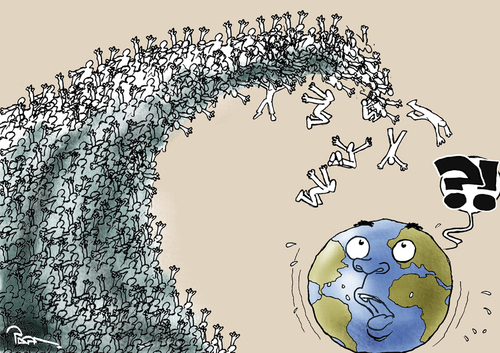
The Malthusian theory, Paul Ehrlich, and the Club of Rome all stoked the myth of overpopulation.
For more than half a century, the world has feared that human numbers would overwhelm the planet’s ability to sustain life. Governments warned of famine, resource exhaustion, and ecological collapse. The “population bomb,” they said, was ticking.
This question came to dominate public life in the late twentieth century.
This finds its roots in the 18th century with Thomas Malthus and the Malthusian Theory, and seemed to culminate in the late 60s and early 70s.
In 1968, biologist Paul Ehrlich made his infamous prediction: “Hundreds of millions of people will starve to death…nothing can prevent a substantial increase in the world death rate.” (Paul Ehrlich, The Population Bomb (New York: Ballantine Books, 1968), p. 11) He warned that India could not possibly feed two hundred million more people by 1980. The battle to feed humanity, he said, was already lost.
Ehrlich’s warnings were not novel. They rested on a theory first articulated by Thomas Malthus in 1798: that population grows geometrically while food and resources grow only arithmetically, leading inevitably to scarcity, famine, and collapse. The logic seemed airtight. More people meant more mouths to feed, and therefore less for everyone.
But both Malthus and his modern heirs shared a critical error: they treated human beings only as consumers of resources, not as creators of solutions. They counted mouths, but not minds.
The Church saw something these models missed entirely. As Pope St. John XXIII taught in 1961, “The resources which God in His goodness and wisdom has implanted in nature are well-nigh inexhaustible, and He has at the same time given man the intelligence to discover ways and means of exploiting these resources for his own advantage and his own livelihood.” (Mater et Magistra, 189)
In other words, from the Church’s perspective the problem was never people themselves. Long before the panic began, the Church insisted that the central question was not how many people the Earth could hold, but how societies understand the human person. Are human beings merely consumers of resources — or are they also creators, stewards, and bearers of God-given intelligence?
Human creativity is not a fixed quantity. It is a dynamic force — one that can grow, adapt, and respond to challenges. The real question, then, is not whether population would grow, but whether human creativity, cooperation, and moral responsibility would grow with it.
The last fifty years provide a clear answer.
The Population Bomb Never Exploded
Reality delivered a different verdict. India’s population today exceeds 1.4 billion — more than three times Ehrlich’s “impossible” threshold — and Indians are better fed than ever before. Rather than mass starvation, the world experienced the greatest reduction in extreme poverty in human history: a decline of roughly 90 percent since 1990. (World Bank)
So, was there ever an overpopulation problem? The evidence, and the Church’s enduring wisdom, suggest otherwise. This article series examines what actually happened when population grew, why the dire predictions failed, and what damage was done when fear replaced faith in the human person.
The Stakes: Why This Matters
This wasn’t merely an academic debate. Ideas have consequences, and the consequences of population alarmism were devastating—particularly for the world’s poor.
In 1961, even before the panic reached its height, Pope St. John XXIII saw the danger and offered a prophetic warning: “No statement of the problem and no solution to it is acceptable which does violence to man’s essential dignity”. (Mater et Magistra, 191)
Over the following decades, fear of population growth justified policies that would have been unthinkable in any other context. In India during the mid-1970s, more than 11 million people were sterilized—many under coercion, some at gunpoint. In China, the one-child policy led to forced abortions, abandoned daughters, and a demographic catastrophe still unfolding today. In Peru, indigenous women were sterilized without their knowledge or consent.
These weren’t isolated abuses. They were systematic campaigns, often funded by Western governments and international organizations convinced they were saving the planet.
The Church entered this conversation not as a demographic analyst, but as the guardian of human dignity. As Pope St. Paul VI wrote in 1967, “There is the rapid increase in population which has made many fear that world population is going to grow faster than available resources”. (Humanae Vitae, 2)
But the Church insisted on asking a different question: Not “How do we reduce human numbers?” but “How do we build societies that respect every human life?”
The evidence shows that respect for human dignity—not fear of human numbers—is the path to genuine development. Let’s examine what the prophets of doom predicted, and what actually happened.
What the Malthusian Prophets of Doom Predicted
THE 1968 POPULATION BOMB
Paul Ehrlich’s apocalyptic vision captured global attention. His predictions were stark and specific: mass starvation would claim hundreds of millions by 1980, food production could never keep pace with population growth, and environmental collapse was inevitable.
He wasn’t alone. In 1972, the Club of Rome issued its influential report Limits to Growth, concluding that if current growth trends continued unchanged, the limits to growth on Earth would be reached sometime within the next one hundred years—by 2072. (Limits to Growth)
The report predicted: “Given present resource consumption rates and the projected increase in these rates, the great majority of currently nonrenewable resources will be extremely expensive 100 years from now.”
THE MALTHUSIAN THEORY

The Wager That Proved the World Isn’t Running Out
In 1980, economist Julian Simon challenged Paul Ehrlich to a famous bet. Simon argued that human innovation makes resources more abundant, not less. Ehrlich, maintaining his “Population Bomb” stance, chose five metals (copper, chromium, nickel, tin, and tungsten) that he was certain would rise in price due to scarcity by 1990.
The Result? Despite the world population increasing by 800 million during that decade, the price of every single one of those metals dropped significantly. Simon won. The lesson: The human mind—the ‘ultimate resource’—constantly finds substitutes and efficiencies that bypass the physical limits of matter.
These predictions rested on a theory first articulated by Thomas Malthus in 1798: that population grows geometrically (2, 4, 8, 16) while food and resources grow only arithmetically (2, 3, 4, 5), leading inevitably to scarcity, famine, and collapse.
The logic seemed airtight. Population had indeed grown rapidly—from 3 billion in 1960 to over 4 billion by 1974. Poverty and hunger were visible across the developing world. Recent memories of wartime scarcity made shortage seem plausible.
But these models made a critical error: they treated humans as merely consumers of resources, never as creators of solutions. They counted mouths to feed but never hands to work or minds to innovate. They saw people as the problem, not as the answer.
As previously noted, the Church, by contrast, saw something the models missed entirely. As Pope St. John XXIII had already proclaimed in 1961: “The resources which God in His goodness and wisdom has implanted in nature are well-nigh inexhaustible, and He has at the same time given man the intelligence to discover ways and means of exploiting these resources for his own advantage and his own livelihood.” (Mater et Magistra, 189)
In other words, human creativity is not a fixed constant but a dynamic force—one that can grow faster than population itself. The question is: Did reality confirm the Malthusian nightmare, or vindicate the Church’s confidence in human creativity? The data provide a clear answer.
At A Glance
PART 1 — Overpopulation Fears and the Malthusian Legacy
What we’ve seen:
- Overpopulation fears are not new; they recur whenever societies face stress.
- Malthusian predictions have repeatedly failed because they underestimate human creativity and adaptation.
- The “population bomb” narrative was built on linear projections that ignored innovation, institutions, and moral agency.
What comes next:
- We turn from predictions to evidence: what actually happened when populations grew?
Read Part 2: Is the World Overpopulated?
Read Part 3: Missing the Real Problem: Consumerism and Overconsumption




CAPP-USA (Centesimus Annus Pro Pontifice, Inc.) is the United States affiliate of the Vatican-based pontifical foundation of Fondazione Centesimus Annus Pro Pontifice, established by Pope St. John Paul II in 1993 to promote Catholic Social Teaching in fidelity to the Magisterium of the Catholic Church. CAPP-USA is a 501(c)(3) nonprofit organization.