Three Questions at the Heart of Magnifica Humanitas
by CAPP-USA
Pope Leo XIV’s first encyclical is brand new — and it will require much prayer and discernment in the days ahead. But before anything else, it asks us three questions. Let’s see how it answers them.
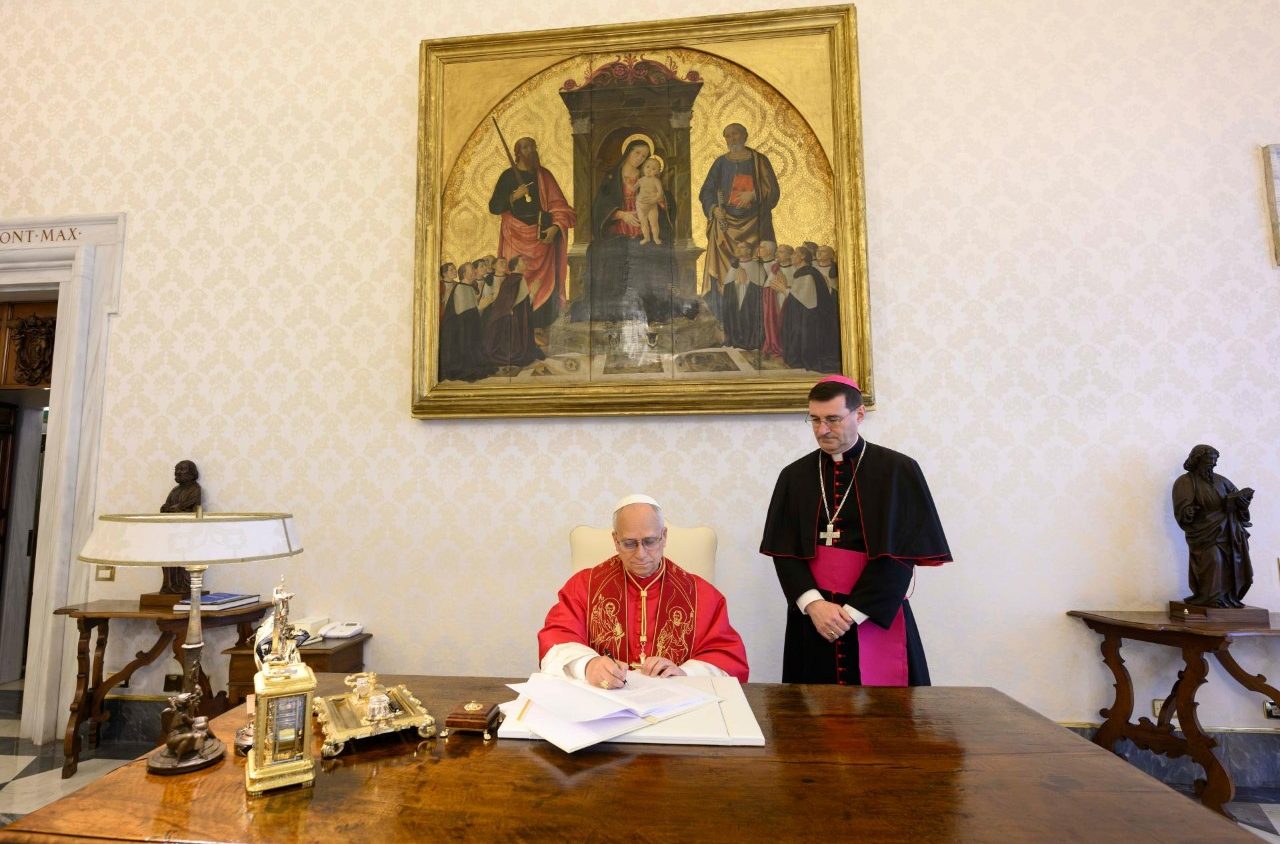
Pope Leo XIV signs his first encyclical, Magnifica Humanitas. (Vatican Media)
On May 15, 2026 — the 135th anniversary of Rerum Novarum, Pope Leo XIII’s great encyclical on labor and capital — Pope Leo XIV released Magnifica Humanitas, his first encyclical and an ambitious entry into one of the defining questions of our age: what does the rapid rise of artificial intelligence mean for human dignity, work, solidarity, and the future of society?
The document is long, rich, and demanding. It will reward slow reading and serious study. The Catholic social tradition it draws upon stretches back 135 years and across dozens of pontificates. It will take time to absorb what Pope Leo XIV has placed before us.
But here is what is initially striking about the encyclical: it does not begin with answers. It begins with questions.
In paragraph 6, after a diagnosis of the technological moment we inhabit, the Pope pauses and turns to address the conscience of every reader directly.
He writes that “crucial questions impose themselves on our conscience and can no longer be avoided.” (Pope Leo XIV, 6) And then he poses three:
“Where are we going?”
“Toward what goal do we wish to orient ourselves?”
“What direction should we choose as a people and as a human community?”
Notice what Pope Leo XIV is doing. He is not beginning with condemnation. He is not leading with a policy proposal or a regulatory framework. He is beginning—as a pastor—with the questions we cannot responsibly avoid.
These questions were so important as an organizing theme in the encyclical that he reiterated them in his address to CAPP during a private audience only 5 days after the encyclical's release.
So let us examine how the encyclical answers each one.
QUESTION #1 OF MAGNIFICA HUMANITAS
“Where Are We Going?”
This is the diagnostic question — and the encyclical’s answer is sobering.
If we continue on our current trajectory without deliberate moral intervention, the document suggests we are drifting toward what the Pope calls the “Babel syndrome”: a world shaped by the idolatry of profit, the flattening of human difference into data, and the illusion that a single digital language can capture everything — including the mystery of the human person.
The warning is sharpened in (Magnifica Humanitas, 5), where he identifies a structural problem few other voices have named so plainly: the main drivers of technological development are private entities whose resources and capacity to act now surpass those of many governments.
“Technological power takes on an unprecedented, predominantly ‘private’ aspect, which makes it even more challenging to discern, govern and direct such power toward the common good.” (Pope Leo XIV, 5)
This is not an abstract concern. When power escapes democratic accountability — when there is no mechanism for the common good to assert itself over the logic of profit — the vulnerable lose. They always do.
Rerum Novarum said the same thing about unregulated industrial capitalism in 1891. Magnifica Humanitas says it about unregulated AI and digital power in 2026.
“More power does not necessarily imply something better… if technological development advances without a corresponding ethical and social progress, the result may be an increase in means without a growth in humanity: ‘having more’ without ‘being more.’” (Pope Leo XIV, 94)
The encyclical also identifies a deeper ideological drift: a growing tendency—which it names directly as a pathology—to evaluate human beings by their productivity.
In (Magnifica Humanitas, 51), the Pope warns against “the ideology that suggests that every person must earn or justify his or her own worth, to the point of attributing greater value to those who are more efficient or effective.”
This is the culture we are headed for—if we do not choose differently. And at the furthest horizon of this drift, the document places transhumanism and posthumanism—philosophies that treat human limits not as part of our dignity but as engineering problems to be solved. The Pope does not dismiss these currents; he takes them seriously enough to name them as the ideological destination of an uncorrected course. (Magnifica Humanitas, 115, 116, 252)
In short: where are we going? Toward a world where the mystery of the person is reduced to data, where power concentrates in private hands beyond democratic reach, and where human beings are measured by what they produce — unless we make a different choice.
QUESTION #2 OF MAGNIFICA HUMANITAS
“Toward What Goal Do We Wish to Orient Ourselves?”
This is the teleological question — the question of ends — and here the encyclical stands squarely within the tradition of Catholic Social Teaching that Pope St. John Paul II created CAPP to promote.
The goal is not complicated, but it is demanding. It is integral human development: the authentic flourishing of every person in every aspect of life — spiritual, material, cultural, moral, relational — with no one left behind, and no part of the person reduced to a means.
Pope Leo XIV is direct about this in (Magnifica Humanitas, 14). The standards of discernment are the principles Catholics have been given: “the dignity of the human person, the universal destination of goods, the preferential option for the poor, care for our common home, and peace.”
These are not new. They are the accumulated wisdom of 135 years of the Church’s engagement with the modern world. But they must now be applied — concretely — to AI governance, data systems, platforms, and algorithms.
And this living tradition continues: St. John Paul II’s Laborem Exercens (1981) affirmed the priority of labor over capital and work as participation in God’s creation, while Pope Francis in Fratelli Tutti (2020) warns against economies that exclude the vulnerable, including gig workers on the periphery.
“Development is truly human when it places people at the center instead of the accumulation of wealth.” (Magnifica Humanitas, 83)
The encyclical deepens the goal as it moves forward.
Integral human development is not merely a political or economic goal — it has a theological horizon.
Pope Leo XIV invokes the image of the New Jerusalem, the “civilization of love” that both Pope St. John XXIII and Pope St. John Paul II held out as the ultimate direction of Christian social action.
The goal we orient ourselves toward is, in the end, not a technocratic utopia but a human community in which every person is received as a gift, not evaluated as a resource.
This is why the encyclical treats human dignity not as one value among others to be weighed in a cost-benefit analysis, but as the starting point and criterion of all legitimate development.
Any technology — any system, platform, or algorithm — that diminishes human dignity is not progress. It is regression, regardless of what the efficiency metrics say.
QUESTION #3 OF MAGNIFICA HUMANITAS
“What Direction Should We Choose as a People and as a Human Community?”
This is the practical question, and it is answered with one of the encyclical’s most memorable images.
Pope Leo XIV reaches back to the Book of Nehemiah. After the exile, Nehemiah returned to Jerusalem to find the walls in ruins and the community in despair. He did not rebuild the city alone. He assigned “each person their own section of the wall” and called the whole people to the work together.
The encyclical holds this image up as the model for what the Church — and indeed all people of good will — are called to do in the face of the AI revolution.
“All are given their own section of the wall: scientists and researchers, entrepreneurs and workers, educators and legislators, civil society, popular movements and faith communities… We should not be intimidated by tensions or differences because they can become creative forces when guided by shared responsibility.” (Magnifica Humanitas, 13)
The direction, in other words, is not withdrawal, resignation, or the passive hope that technology will regulate itself. Nor is it the opposite error: a panicked rejection of AI as inherently dehumanizing.
The direction is engaged, collaborative, morally grounded stewardship.
The encyclical is concrete about what this looks like. In paragraph 14, Pope Leo XIV calls for “responsible planning, the assessment of human and social impact, the inclusion of the most vulnerable, the promotion of digital literacy and guiding research and industry toward justice and peace.”
These are not vague aspirations. They are practical criteria — derived from CST — that can and must be applied to technology governance. But the encyclical also insists the choice is ultimately a choice between two cultures, two ways of being human together.
In Magnifica Humanitas, 16, Pope Leo XIV puts it in its most compressed form:
“The task that stands before us is that of being builders of communion, rather than architects of Babel. We are to be servants of the coming Kingdom, instead of lords of towers destined for ruin.”
Builders of communion. That is the direction.
Not the domination of nature, of other people, or of the future by those with the most processing power — but the patient, humble, collaborative work of building a world in which every person finds a place.
Much Remains to Be Discerned
Magnifica Humanitas is new. It is a text that will reward re-reading. There are chapters on the history of Catholic Social Teaching, on the specific pathologies of digital culture, on the ethics of AI governance, and on the theological vision of integral ecology and the common home that have not been touched here.
But beginning with the three questions—and tracing how the encyclical answers them—gives us something solid to stand on as the wider conversation begins.
Pope Leo XIV has asked good questions. He has also answered them — not in a tidy list but woven through the whole of a rich and serious document.
The encyclical is structured so that the answers deepen as you read, which is itself a statement about how discernment works.
The next step is ours.
THE THREE QUESTIONS OF MAGNIFICA HUMANITAS — SUMMARY
- Where are we going? Toward a Babel of private technological power, efficiency-as-ideology, and the reduction of the person to data — unless we intervene.
- Toward what goal? Integral human development: the flourishing of every person in every dimension, with no one left behind — a goal with a theological horizon in a civilization of love.
- What direction should we choose? The direction of Nehemiah: each person taking their section of the wall, guided by the principles of Catholic Social Teaching, building communion rather than Babel.
Magnifica Humanitas was released on May 15, 2026, the 135th anniversary of Rerum Novarum.