Solidarity in Catholic Social Teaching

Is Radical Love

We are Our Brother’s Keeper

No Less Than an Encounter with God

Committed to the Common Good

Suffers for the Truth

Fundamental Among Nations

Rooted in Human Dignity. Committed to the Common Good.

Pope St. John Paul II defined solidarity as much more than a feeling.
Solidarity “is a firm and persevering determination to commit oneself to the common good” and is fundamental to the Christian view of social and political organization.

Pope St. John Paul II, 38

Pope Leo XIV reminded us that solidarity is our deepest connection with others.
“Solidarity…is the concrete recognition that the future of each individual is connected to the future of all.”

Pope Leo XIV, 73

Pope Francis told us that we are brothers and sisters under the care of our common Father, God Himself.
“[A]ll men and women are called to live as one, each taking care of the other”. We are “our brothers’ keeper”.

Pope Francis, 3

Human Dignity is the foundation. Solidarity is what that dignity demands of us in relationship with others.

Solidarity Flows From Human Dignity

Catholic social teaching begins with the dignity of the human person.

As early as 1891, Pope Leo XIII insisted that we must “respect in every man his dignity as a person.” (Rerum Novarum, 20)

Pope St. John XXIII later taught that individual human beings are the “foundation, the cause and the end of every social institution.” (Mater et Magistra, 219)

Pope Leo XIV carries that same understanding of the human person forward: “The human person is not an isolated individual, but a being in relationship.” (Magnifica Humanitas, 73)

And therefore: “The future of each individual is connected to the future of all.” (Magnifica Humanitas, 73)

Human Dignity is the foundation. Solidarity is what that dignity demands of us in relationship with others.

Learn more about Human Dignity

As a virtue, solidarity requires that same “firm and persevering determination” to strive for the common good.

Solidarity Is a Commitment to the Common Good

Pope St. John Paul II tells us first what solidarity is not: “A feeling of vague compassion or shallow distress at the misfortunes of others.” Rather, as we saw above, solidarity is that same “firm and persevering determination to commit oneself to the common good.(Sollicitudo Rei Socialis, 38)

This commitment to a social order directed toward the good of all runs deep in Catholic social teaching.

Pope Leo XIV takes up that tradition directly: “The Church’s social teaching emphasizes that solidarity is both a principle and a virtue.” (Magnifica Humanitas, 75)

As a principle, it recognizes our interdependence: “The good of each person depends on the good of others.” (Magnifica Humanitas, 75)

As a virtue, solidarity requires that same “firm and persevering determination” to strive for the common good, “with particular attention to those most in need.” (Magnifica Humanitas, 75)

Solidarity moves us from knowing we are connected to living as though we truly are.

Learn more about the Common Good

Read More

Pope Pius XI taught: “Social charity…ought to be as the soul of this order.(Quadragesimo Anno, 88)

“Pope Francis noted solidarity is ‘a way of making history’ that creates communities and not just masses of individuals…It requires a modest and shared way of life.” (Magnifica Humanitas, 75)

But interdependence alone is not solidarity. True solidarity begins when those connections become a conscious commitment to others.

Solidarity Is More Than Interdependence

Pope St. Paul VI recognized that our growing interdependence creates moral obligations: “The reality of human solidarity brings us not only benefits but also obligations.(Populorum Progressio, 17)

Pope Leo XIV observes that modern life has intensified this reality, creating a kind of “de facto solidarity.” Global markets, migration, communications and technology increasingly bind people and nations together.

But interdependence alone is not solidarity.

True solidarity begins when those connections become a conscious commitment to others: “We are not merely neighbors to one another, but entrusted to each other.” (Magnifica Humanitas, 74)

Pope Leo calls us to transform the bonds that already connect us into “paths of sharing, cooperation and mutual care.” (Magnifica Humanitas, 74)

Being connected is a fact. Solidarity is the choice to accept responsibility for those connections.

The basis of solidarity is to love one another as Jesus loves us.

Solidarity Is Radical Love

At the Last Supper Jesus said: “A new commandment I give to you, that you love one another: just as I have loved you, you also are to love one another.” (John 13:34)

This is a radical command.

We are not merely asked to feel concern for another person. We are called to love as Christ loves.

Pope Francis described this as a willingness to “lose ourselves” for the sake of others. (World Day of Peace, 2014, 4)

Pope Benedict XVI made the demand equally stark: “Truth and justice must stand above my comfort and physical well-being or else my life itself becomes a lie.” (Spe Salvi, 38)

Solidarity can therefore require sacrifice.

Solidarity is love made concrete—even when love costs us something.

Read More

Pope Leo XIV says it calls for “the ability to forego immediate benefits in order to create opportunities for others in the future,” as well as a willingness to challenge habits and privileges when they prevent others from living with dignity. (Magnifica Humanitas, 75)

The poor are not simply problems to be solved or categories to be studied. They are brothers and sisters. Solidarity requires action.

Solidarity Means Standing With the Poor and Vulnerable

Concern for those who are vulnerable has marked modern Catholic social teaching from its beginning.

In Rerum Novarum, Pope Leo XIII confronted a social order in which working people had been left “isolated and helpless.” (Rerum Novarum, 3)

Pope St. Paul VI later warned that “the hungry nations of the world cry out to the peoples blessed with abundance.” (Populorum Progressio, 3)

Pope Leo XIV states: “By her very nature the Church is in solidarity with the poor, the excluded, the marginalized and all those considered the outcast of society.” (Dilexi Te, 111)

Solidarity therefore requires both personal action and concern for the conditions and structures that contribute to poverty, exclusion or marginalization.

Learn more about the Preferential Option for the Poor

Read More

This is not a mission reserved to a few specialists or charitable organizations. It belongs to Christian discipleship itself.

The poor are not simply problems to be solved or categories to be studied. They are brothers and sisters.

Solidarity, then, is not passive. It asks us to take part in the life of our families, communities, workplaces, associations and civic institutions.

Solidarity Requires Participation

Participation has long been part of the Church’s understanding of a just social order.

Pope St. John XXIII insisted that social institutions should encourage people to “take an active part in the ordering of their lives.” (Mater et Magistra, 65)

Pope Leo XIV explains that this means “staying informed, engaging with others, making one’s voice heard and contributing to public decisions and choices,” while also “assuming real responsibility so that the common good is achieved through shared decision-making.” (Magnifica Humanitas, 73)

Solidarity, then, is not passive.

It asks us to take part in the life of our families, communities, workplaces, associations and civic institutions—and to accept the responsibilities that belong to us.

The common good is not something others create for us. Solidarity calls each of us to help build it.

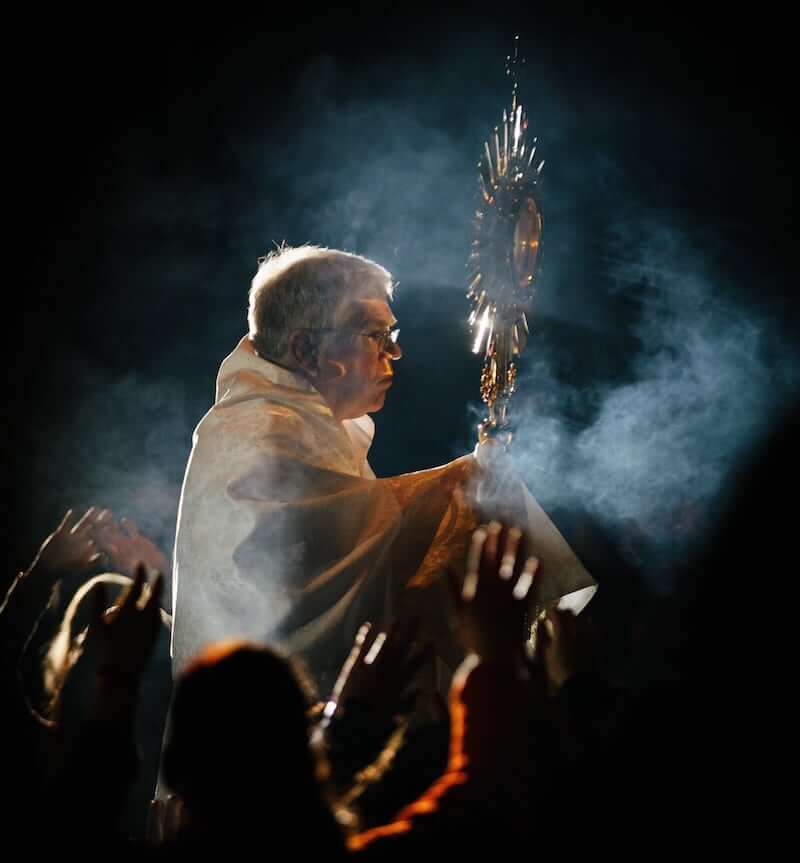
A priest carries the Holy Eucharist in a monstrance amid a cloud of incense and crowd of worshippers, showing that solidarity must flow from faith

Solidarity Flows From Faith

For Christians, solidarity is not merely a social or political ideal. It is rooted in our relationship with God.

Pope Benedict XVI explained: “Love of neighbor…consists in the very fact that, in God and with God, I love even persons whom I do not like or even know. (Deus Caritas Est, 18)

How is that possible?

“This can only take place on the basis of an intimate encounter with God.” (Deus Caritas Est, 18)

And: “Love of neighbor is a path that leads to the encounter with God, and…closing our eyes to our neighbor also blinds us to God.” (Deus Caritas Est, 16)

Pope Leo XIV deepens this connection: “For the Christian community, solidarity finds its source in the mystery of Christ and is nourished by the Eucharist.” (Magnifica Humanitas, 88)

Baptism and Confirmation unite us in Christ “so that we may become one Body and one Spirit, one heart and one soul,” while the Eucharist “nurtures our belonging to the Body of Christ and teaches us how to share.” (Magnifica Humanitas, 88)

Solidarity therefore flows from faith because love of God and love of neighbor cannot ultimately be separated.

Solidarity in the Digital Age

Pope Leo XIV extends the principle of solidarity directly to the digital world:

Solidarity demands that decisions regarding data, algorithms, platforms and artificial intelligence take into account not only the immediate benefit for a few, but also the impact on all peoples and on future generations.(Magnifica Humanitas, 76)

This is not an abstract concern. Digital technologies depend on real people: “To speak of solidarity obliges us to recognize the hidden, often exploited workers, who sustain algorithmic systems.” (Magnifica Humanitas, 109)

Technology can expand knowledge and opportunity, but it can also deepen inequality, concentrate power and leave people on the margins.

Pope Leo therefore asks whether new technologies “truly help individuals and peoples to become more humane and fraternal.” (Magnifica Humanitas, 85)

That is the measure of technological progress: does it serve the dignity and good of the whole human family, or only those who control and benefit most from it?

Learn more about Artificial Intelligence and Catholic Social Teaching

Pope Leo XIV extends the principle of solidarity directly to the digital world.

Solidarity in the Digital Age

Pope Leo XIV extends the principle of solidarity directly to the digital world:

Solidarity demands that decisions regarding data, algorithms, platforms and artificial intelligence take into account not only the immediate benefit for a few, but also the impact on all peoples and on future generations.(Magnifica Humanitas, 76)

This is not an abstract concern. Digital technologies depend on real people: “To speak of solidarity obliges us to recognize the hidden, often exploited workers, who sustain algorithmic systems.” (Magnifica Humanitas, 109)

Technology can expand knowledge and opportunity, but it can also deepen inequality, concentrate power and leave people on the margins.

Pope Leo therefore asks whether new technologies “truly help individuals and peoples to become more humane and fraternal.” (Magnifica Humanitas, 85)

That is the measure of technological progress: does it serve the dignity and good of the whole human family, or only those who control and benefit most from it?

Learn more about Artificial Intelligence and Catholic Social Teaching

Solidarity asks what we owe one another. Subsidiarity asks who should act—and at what level.

Solidarity and Subsidiarity Need Each Other

Pope Leo XIV makes their relationship explicit: “When subsidiarity is not linked to solidarity, it ends up becoming merely the protection of particular interests; when solidarity is not supported by subsidiarity, it degenerates into a form of welfare that does not foster responsibility.(Magnifica Humanitas, 73)

Pope Pius XI gave the Church the classic formulation of subsidiarity, warning that it is “an injustice” to transfer to larger and higher bodies functions that smaller bodies can perform for themselves. (Quadragesimo Anno, 79)

Pope Benedict XVI later emphasized: “The principle of subsidiarity must remain closely linked to the principle of solidarity and vice versa.” (Caritas in Veritate, 58)

Solidarity asks what we owe one another.

Subsidiarity asks who should act—and at what level.

Pope Leo connects both principles to participation: “Solidarity is expressed when each person, both individually and collectively, takes part in the life of the community.” (Magnifica Humanitas, 73)

Learn more about Subsidiarity

Read More

Together, solidarity and subsidiarity protect both responsibility and participation—calling us to contribute to the common good rather than remain either isolated from one another or merely passive recipients of assistance.

Solidarity Applies to Individuals, Communities, and Nations

Solidarity does not end with personal responsibility.

Pope St. Paul VI made the implications unmistakable: “The social question ties all men together, in every part of the world.” (Populorum Progressio, 17)

“In a world marked by increasingly close connections between people, communities and nations, solidarity also takes on a global dimension.” (Pope Leo XIV, 76)

Pope St. John Paul II made the point even more broadly: “Peace and prosperity, in fact, are goods which belong to the whole human race.” (Centesimus Annus, 27)

And Pope Benedict XVI explained: “Concern for our neighbor transcends the confines of national communities and has increasingly broadened its horizon to the whole world.” (Deus Caritas Est, 30)

Solidarity therefore reaches from the person and the family to communities, institutions and nations.

The common good cannot stop at our own doorstep—or at our national borders.

Read More

Pope St. John XXIII recognized the expanding bonds among peoples, pointing to the “mutual ties binding the men of our age one to the other.” (Mater et Magistra, 66)

The Second Vatican Council likewise taught: “It is a very important duty of the advanced nations to help the developing nations in discharging their…responsibilities.” (Gaudium et Spes, 86)

Pope Leo XIV carries this teaching directly into our own time:

Solidarity does not end with personal responsibility. It extends to nations.

Solidarity Applies to Individuals, Communities, and Nations

Solidarity does not end with personal responsibility.

Pope St. Paul VI made the implications unmistakable: “The social question ties all men together, in every part of the world.” (Populorum Progressio, 17)

“In a world marked by increasingly close connections between people, communities and nations, solidarity also takes on a global dimension.” (Pope Leo XIV, 76)

Pope St. John Paul II made the point even more broadly: “Peace and prosperity, in fact, are goods which belong to the whole human race.” (Centesimus Annus, 27)

And Pope Benedict XVI explained: “Concern for our neighbor transcends the confines of national communities and has increasingly broadened its horizon to the whole world.” (Deus Caritas Est, 30)

Solidarity therefore reaches from the person and the family to communities, institutions and nations.

The common good cannot stop at our own doorstep—or at our national borders.

Read More

Pope St. John XXIII recognized the expanding bonds among peoples, pointing to the “mutual ties binding the men of our age one to the other.” (Mater et Magistra, 66)

The Second Vatican Council likewise taught: “It is a very important duty of the advanced nations to help the developing nations in discharging their…responsibilities.” (Gaudium et Spes, 86)

Pope Leo XIV carries this teaching directly into our own time:

What Must I Do?

“We are not merely neighbors to one another, but entrusted to each other.” (Pope Leo XIV, 74)

That means refusing indifference to what happens to others and accepting responsibility for the people and communities entrusted to us.

Pope St. Paul VI insisted that this responsibility reaches the conscience of each person. Authentic development requires “great generosity, willing sacrifice and diligent effort.” (Populorum Progressio, 47)

It also means transforming the economic, cultural and technological bonds that already connect us into “paths of sharing, cooperation and mutual care.” (Pope Leo XIV, 74)

For Christians, solidarity is therefore not simply something we believe. It is something we do.

Pope Francis described this as weaving “a fabric of fraternal relationships marked by reciprocity, forgiveness and complete self-giving.” (World Day of Peace, 2014, 10)

We do not merely live beside one another. We are called to live for one another.

Read More

Solidarity is lived by participating in the life of our families, workplaces, communities and civic institutions; by caring for those who are poor, excluded or vulnerable; and by being willing to sacrifice immediate advantages when they prevent others from living with dignity.

Pope Leo, quoting Pope St. John Paul II, describes solidarity as “a firm and persevering determination” to strive for the common good. (Magnifica Humanitas, 75)

135 Years of Catholic Social Teaching

Pope Leo XIV’s teaching on solidarity does not stand alone.

Modern Catholic social teaching stretches from Pope Leo XIII’s Rerum Novarum in 1891 through Pius XI, John XXIII, Paul VI, John Paul II, Benedict XVI and Francis to Pope Leo XIV today.

Pope Pius XI called Rerum Novarum the “Magna Charta upon which all Christian activity in the social field ought to be based.(Quadragesimo Anno, 39)

Pope St. Paul VI described how that tradition develops: “The eightieth anniversary of the publication of the encyclical Rerum Novarum, the message of which continues to inspire action for social justice, prompts us to take up again and to extend the teaching of our predecessors, in response to the new needs of a changing world.” (Octogesima Adveniens, 1)

That is the continuity of Catholic social teaching: enduring principles applied faithfully to new circumstances. From the upheavals of the Industrial Revolution to globalization, migration, economic development, digital platforms and artificial intelligence, the circumstances change.

The principles do not.

Magnifica Humanitas, issued by Pope Leo XIV on the 135th anniversary of Rerum Novarum, continues that living tradition.

Explore CAPP-USA’s Magisterial Resources

Pope Leo XIII was integral to Catholic social teaching origins and addressing socialism.

135 Years of Catholic Social Teaching

Pope Leo XIV’s teaching on solidarity does not stand alone.

Modern Catholic social teaching stretches from Pope Leo XIII’s Rerum Novarum in 1891 through Pius XI, John XXIII, Paul VI, John Paul II, Benedict XVI and Francis to Pope Leo XIV today.

Pope Pius XI called Rerum Novarum the “Magna Charta upon which all Christian activity in the social field ought to be based.(Quadragesimo Anno, 39)

Pope St. Paul VI described how that tradition develops: “The eightieth anniversary of the publication of the encyclical Rerum Novarum, the message of which continues to inspire action for social justice, prompts us to take up again and to extend the teaching of our predecessors, in response to the new needs of a changing world.” (Octogesima Adveniens, 1)

That is the continuity of Catholic social teaching: enduring principles applied faithfully to new circumstances. From the upheavals of the Industrial Revolution to globalization, migration, economic development, digital platforms and artificial intelligence, the circumstances change.

The principles do not.

Magnifica Humanitas, issued by Pope Leo XIV on the 135th anniversary of Rerum Novarum, continues that living tradition.

Explore CAPP-USA’s Magisterial Resources

FAQs

Q: What does solidarity mean in Catholic Social Teaching?

A: Solidarity recognizes that we belong to one human family and are responsible for one another and for the common good.

Pope St. John Paul II defined solidarity as: “A firm and persevering determination to commit oneself to the common good.(Sollicitudo Rei Socialis, 38)

Pope Leo XIV explains why: “The good of each person depends on the good of others.” (Magnifica Humanitas, 75)

Solidarity is therefore both a social principle and a personal virtue.

Q: Is solidarity the same as charity?

A: No. But the two are inseparable in Christian life.

Charity is the theological virtue of love of God and neighbor. Solidarity is one way that love takes social form.

Pope St. John Paul II called solidarity “undoubtedly a Christian virtue” and explained that, in the light of faith, it takes on the Christian dimensions of generosity, forgiveness and reconciliation. (Sollicitudo Rei Socialis, 40)

Solidarity recognizes our interdependence and turns love of neighbor into responsibility for one another and for the common good.

Q: What is the difference between solidarity and subsidiarity?

A: Solidarity emphasizes our responsibility for one another and for the common good.

Subsidiarity protects the responsibility and freedom of persons, families, communities and smaller institutions by ensuring that higher authorities assist rather than unnecessarily replace them.

Catholic social teaching insists that the two remain together.

Pope Benedict XVI taught: “The principle of subsidiarity must remain closely linked to the principle of solidarity and vice versa.(Caritas in Veritate, 58)

Pope Leo XIV reiterates the point: subsidiarity without solidarity can become protection of particular interests, while solidarity without subsidiarity can weaken responsibility.

Learn more about Subsidiarity

Q: Why does solidarity flow from human dignity?

A: Because the human person is not made to live in isolation.

Every person is created in the image of God and possesses an inherent dignity. But we are also created for relationship with others.

Pope Leo XIV teaches that each person’s future is bound up with everyone else’s — that’s what makes dignity relational, not just individual. (Magnifica Humanitas, 73)

Respect for human dignity therefore cannot stop with recognition of another person’s rights. It calls us to accept responsibility for one another.

Human Dignity is the foundation. Solidarity is what that dignity demands of us in relationship with others.

Learn more about Human Dignity

Q: Is solidarity only about helping the poor?

A: No. Solidarity extends to the whole human family.

But it has a particular concern for those who are poor, excluded, marginalized or vulnerable.

Pope Leo XIV states: “By her very nature the Church is in solidarity with the poor, the excluded, the marginalized and all those considered the outcast of society.” (Dilexi Te, 111)

Solidarity with the poor is therefore not an optional concern added to Christian faith. It belongs to Christian discipleship itself.

Learn more about the Preferential Option for the Poor

Q: Does solidarity apply to governments and nations?

A: Yes. Solidarity begins with persons, but it does not end with them.

Individuals, families, communities, institutions and nations all have responsibilities toward the common good.

Pope St. Paul VI taught that “the social question ties all men together, in every part of the world.” (Populorum Progressio, 3)

Pope Leo XIV carries that teaching forward: “In a world marked by increasingly close connections between people, communities and nations, solidarity also takes on a global dimension.” (Magnifica Humanitas, 76)

Pope St. John Paul II likewise taught that “peace and prosperity…are goods which belong to the whole human race.” (Centesimus Annus, 27)

Solidarity has no natural stopping point short of the whole human family.

Q: What does Pope Leo XIV teach about solidarity?

A: Pope Leo XIV gives the principle of solidarity a major new contemporary treatment in Magnifica Humanitas.

He teaches that solidarity flows from the Christian understanding of the human person and recognizes that our lives and futures are interconnected. But interconnectedness alone is not enough. We become truly solidary when those bonds become a conscious choice to accept responsibility for one another.

Pope Leo XIV describes solidarity as both “a principle and a virtue.” As a principle, it recognizes our interdependence; as a virtue, it calls us to a determined commitment to the common good, particularly to those most in need. (Magnifica Humanitas, 74-75)

He also joins solidarity closely to subsidiarity, participation and responsibility, and extends it to the challenges of our own time—including technology, data, algorithms and artificial intelligence.

In doing so, Pope Leo XIV does not replace the social teaching of his predecessors. He applies its enduring principles to the circumstances of our own time.

Q: How can Catholics practice solidarity?

A: Catholics practice solidarity by refusing indifference to what happens to others, participating in the communities to which they belong, caring for those who are vulnerable, and accepting responsibility for the common good.

Solidarity touches how we live our family lives, use our possessions, exercise our professions, conduct business and participate in civic life.

For Christians, solidarity is not simply something we believe.

It is something we do.

Three Key Principles

Catholic social teaching is built on three foundational principles - Human DignitySolidarity and Subsidiarity. Human Dignity, embodied in a correct understanding of the human person, is the greatest. The others flow from it. Good governments and good economic systems find ways of fostering the three principles.

Human Dignity

This means a correct understanding of the human person and of each person’s unique value. All Catholic social teaching flows from this: the inherent dignity of every person that comes from being made in God’s image.

Solidarity

Solidarity is not “a feeling of vague compassion or shallow distress at the misfortunes of others. It is a firm and persevering determination to commit oneself to the common good”. (Pope St. John Paul II, 38) Love of God and love of neighbor are, in fact, linked and form one, single commandment.

Subsidiarity

Subsidiarity “is a fundamental principle of social philosophy, fixed and unchangeable, that one should not withdraw from individuals and commit to the community what they can accomplish by their own enterprise and industry. So, too, it is an injustice and at the same time a grave evil and a disturbance of right order to transfer to the larger and higher collectivity functions which can be performed and provided for by the lesser and subordinate bodies”. (Pope Pius XI)

Sign Up For Our Newsletter:

CAPP-USA (Centesimus Annus Pro Pontifice, Inc.) is the United States affiliate of the Vatican-based pontifical foundation of Fondazione Centesimus Annus Pro Pontifice, established by Pope St. John Paul II in 1993 to promote Catholic Social Teaching in fidelity to the Magisterium of the Catholic Church. CAPP-USA is a 501(c)(3) nonprofit organization.

Sitemap

Phone: (888) 473-3331
Address: 295 Madison Avenue, 12th Floor, New York, NY, 10017